
Engineering an AI engine for enterprise-grade decision intelligence
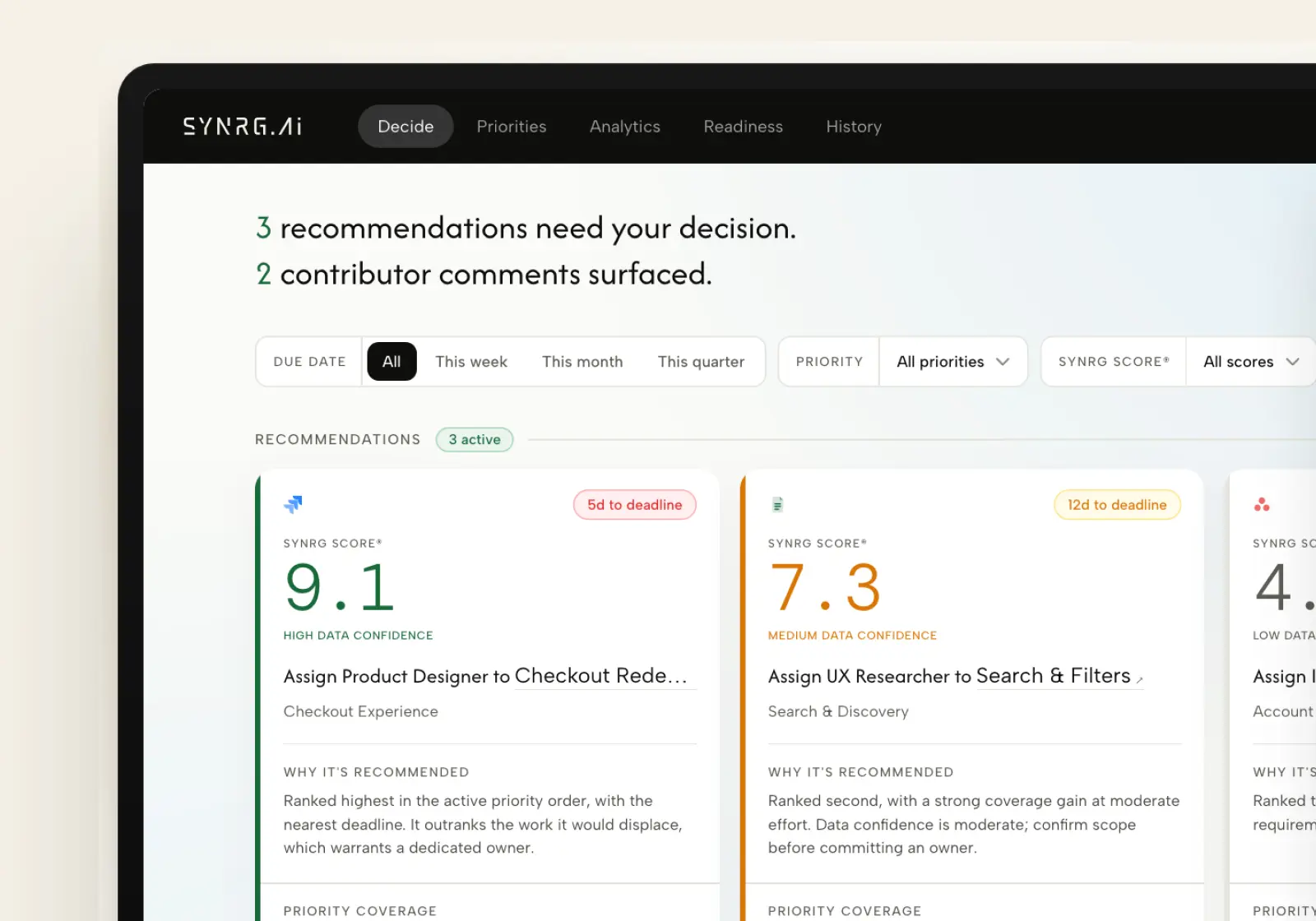
SYNRG.Ai, an AI startup developing a patent-pending decision-intelligence system, engaged AgileEngine to build its scoring-engine MVP. The solutions we implemented enable reliable decision evaluation, empowering enterprise teams to identify and align on high-impact priorities, replacing gut feel with evidence-driven execution.
Industries
Artificial intelligence, Machine learning, Analytics, Enterprise software, Business intelligence
Services
AI engineering, Full-stack development, Backend development, Data engineering, Architecture, R&D, Feature development, QA and software testing
Solutions
AI, Predictive analytics, Data pipeline, Data governance, API, Enterprise application, Product architecture, MVP, Data aggregation, B2B application
Technologies
AWS (Lambda, Amazon SQS, Amazon SNS, Amazon RDS, PostgreSQL, Amazon S3, AWS Amplify, Amazon Cognito, AWS IAM, Amazon CloudWatch), REST API, Jira, JSON
AI tools that powered our workflow
OpenAI GPT-5
Outcomes
and highlights
- Context-bounded RAG pipeline with a filter-first retrieval strategy, fixed token budget, and full retrieval logging
- OpenAI GPT-5 integration with controlled parameters and governance guardrails for recommendation language
Solutions overview
A governed AI engine for fast, actionable, auditable decisions
AgileEngine drove the implementation of the core scoring logic of the client’s flagship product. To ensure accuracy and accountability, the scoring layer uses deterministic calculations, with a separate LLM layer then translating precise math into business recommendations. In addition to the decision engine, our implementation covers the vital data processing and integration foundations, such as model scaffolding infrastructure, RAG pipeline, and Jira write-back.
Key deliverables
- Deterministic, GPT-independent scoring engine leveraging predictable, auditable calculation logic
- Context-bounded RAG pipeline with a filter-first retrieval strategy, fixed token budget, and full retrieval logging
- OpenAI GPT-5 integration with controlled parameters and governance guardrails for recommendation language
- Closed-loop Jira write-back with auditable comments and versioned decision history
- Unified data model laying the groundwork for Jira, Asana, Monday.com, and Airtable integrations
- Recommendation card user interface and data issues panel
- Synthetic Jira dataset test harness for benchmarking time-to-decision and decision velocity pre-rollout, with accept, modify, and dismiss events captured as ground-truth data for future model refinement
- ML staffing-inference scaffolding and NLP maturity-scoring hooks
- Per-tenant organization model supporting enterprise SaaS requirements
- Cloud infrastructure and access-control foundation built with a defined scaling path from static hosting to containerized microservices and then serverless auto-scaling
Technologies
AWS (Lambda, Amazon SQS, Amazon SNS, Amazon RDS, PostgreSQL, Amazon S3, AWS Amplify, Amazon Cognito, AWS IAM, Amazon CloudWatch), REST API, OpenAI GPT-5, Jira, JSON
See more success stories

We turn bold ideas into pixel-perfect, scalable, and smooth digital products. Partner with our world-class engineers, AI specialists, and UX designers to boost your engineering ROI and product outcomes.