
Desktop and mobile solutions for a leader in AI-driven low-code development
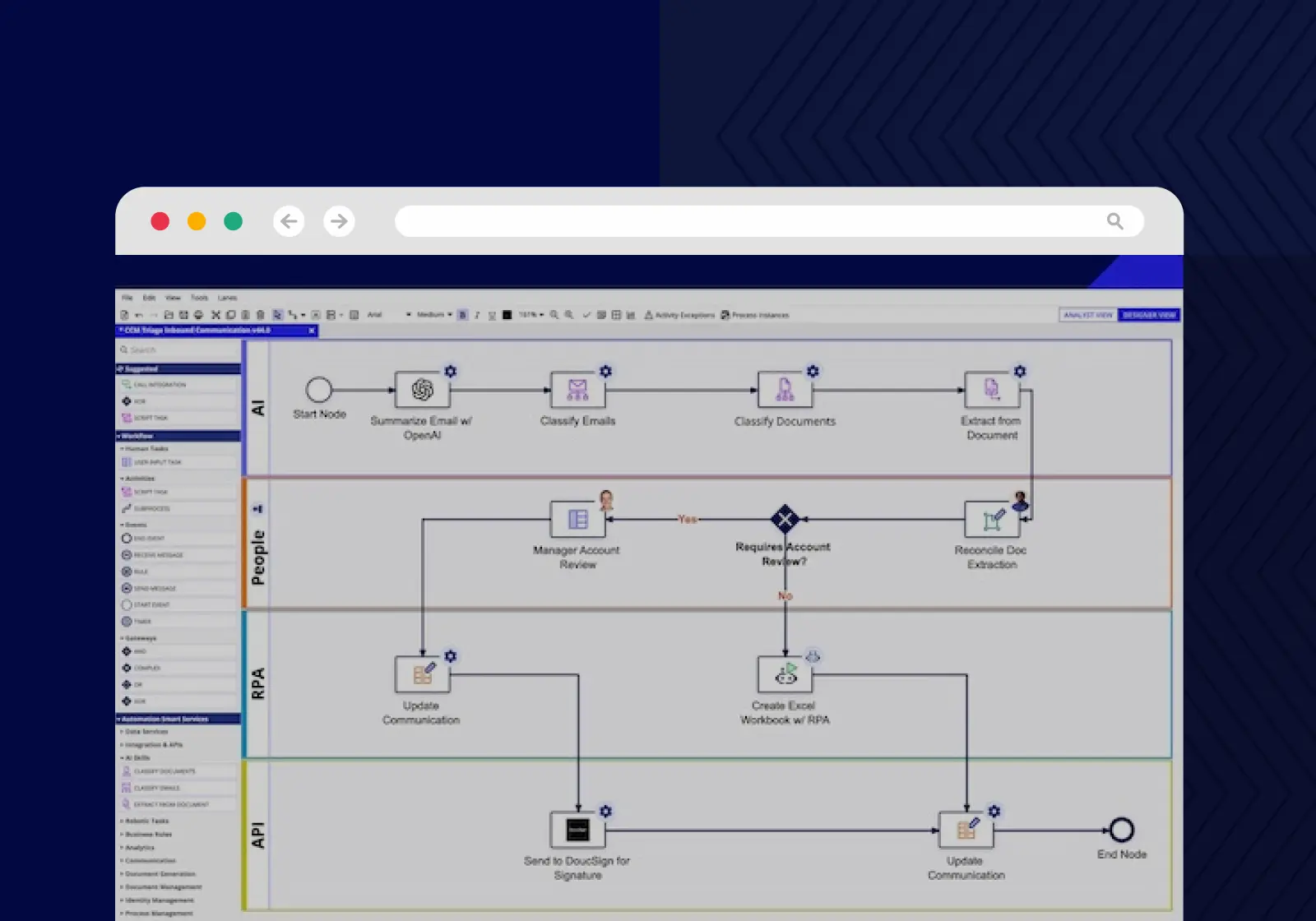
An AI-driven low-code development platform top-listed by Gartner and trusted by 850+ enterprises like Aon, Telus, and PwC engages AgileEngine across mission-critical engineering initiatives. Our team brought the platform’s offline and branding capabilities to desktop and modernized its networking capabilities on iOS. For both of these initiatives, our experts delivered measurable positive impact, improving user experience, engineering efficiency, and system performance.
Industries
Low-code development, Business process automation
Services
Backend development, Mobile development, QA and software testing, DevOps
Solutions
Desktop application, Mobile application, Product architecture, B2B application, Networking, Offline capabilities
Technologies
TypeScript, Java, C#, PowerShell, Electron, Spring, Jersey, React.js, Redux, DuckDB, Objective-C, Swift, AFNetworking, Alamofire
AI tools that powered our workflow
AWS Kiro, Rovo Dev
Outcomes
and highlights
- 2 production-level iOS networking spikes completed in 5 weeks
- 40% reduction in development time for the mobile workstream, with delivery accelerated from a 20-week internal estimate to a projected 12 weeks
- 1 month of upstream refactoring effort avoided for the iOS networking solution, thanks to a proxy architecture implemented and validated by our team
- 3,000-line legacy monolithic Objective-C class mapped and transformed into a clear migration roadmap focused on building new, modern Swift components
- Form resubmissions on desktop made significantly faster, dropping from 5 minutes to seconds after our redesign
Solutions overview
Windows client app: from fixing bugs to redesigning core components
Our team revamped the client’s Windows offline client application to enable enterprise-grade offline and branding functionality, while eliminating deterministic crashes, unrecoverable sync states, and production-readiness blockers. Over the course of the engagement, AgileEngine moved from resolving isolated incidents to proposing architecture and design decisions and owning core app components while improving stability, security, and user experience.
Key deliverables
- Windows installer designed and built end to end by AgileEngine, with advanced whitelabeling support critical to enterprise clients
- Offline sync engine redesigned into a testable, extensible solution serving as the reliable core of the new product
- Elimination of crashes affecting core user experiences, including logout, re-login, network recovery, and data sync
- Automation of zombie-process cleanup, ensuring 100% reliable startup
- Database migrations eliminating manual data-folder deletions
- Security hardening covering encryption integrity, key cleanup on uninstall, and closure of a loophole that allowed sign-in without credentials during environment switching
- Engineering process improvements, including real Windows CI coverage for a previously untested critical encrypted path and memory observability for Electron and JVM
- Integration test suite for Windows and refactoring of an end-to-end testing suite
- UI optimizations: form resubmissions reduced from 5 minutes to seconds, navigation preserved after re-login, and correct locales and up-to-date data displayed
- Technical debt reduction, including build unification, Java/TypeScript type safety, and Jakarta EE migration
Technologies
TypeScript, Java, C#, PowerShell, Electron, Spring, Jersey, React.js, Redux, DuckDB
Implementation of modern networking on iOS
The client’s iOS application relied on a deprecated networking library and a monolithic component with more than 3,000 lines of Objective-C code. To safely replace the legacy parts of the system, our experts chose an incremental modernization and migration strategy accelerated by AI. Within the scope of that strategy, they delivered two production-level spikes and a proxy architectural solution in 5 weeks, demonstrating 40% faster development compared to the client’s estimates.
Key deliverables
- Strangler Fig migration strategy reducing risk by incrementally moving user traffic from the legacy networking layer (AFNetworking) to the new one (Alamofire)
- New production-level Alamofire-based networking spike, written in Swift and validated with unit tests
- Switchboard traffic-routing spike with 52 switches mapped across 10 product verticals, enabling granular remote activation, A/B testing, and fast rollback
- Validation of a proxy architecture that preserves compatibility with existing consumers, avoiding approximately 1 month of upstream refactoring
- Full inventory of the legacy networking client responsibilities, covering 52 networking functions mapped to business verticals
- Broader adoption of AI-assisted engineering pioneered by our experts, reducing ramp-up friction for the client’s teams
- Modernization roadmap for modularization, modern Swift best practices, structured concurrency, async/await, and stronger error handling
Technologies
Objective-C, Swift, AFNetworking, Alamofire, AWS Kiro
See more success stories
We turn bold ideas into pixel-perfect, scalable, and smooth digital products. Partner with our world-class engineers, AI specialists, and UX designers to boost your engineering ROI and product outcomes.