
![A smartphone and a tablet with monetization elements (banner ad and in-app purchase button) displayed on the screen]](https://agileengine.com/wp-content/uploads/2026/03/How-Do-Free-Apps-Make-Money_-Monetization-Explained.webp)
Have you noticed that most (if not all) of the apps on your phone have been free to install? Despite how resource-intensive mobile app development can be, 95% of apps on the App Store and 97% on Google Play don’t require upfront payment. So how do you make money from a free app, especially given all the costs, time, and specialized expertise needed to build and maintain it?
Mobile applications are one of the most commercially active segments of the software market.
Based on the latest economic projections, the global mobile application market will grow from USD 333.93 billion in 2025 to USD 391.3 billion in 2026. Surprisingly, paid apps account for only a small fraction of this growth. For most app businesses, monetization begins after installation rather than at the point of download.
This article examines key monetization models and strategies across app categories, offering an in-depth analysis of how free apps generate revenue.
What “free app monetization” means
Practically speaking, free app monetization refers to how apps generate revenue without charging users to download them or access basic functionality. Instead of asking for money upfront, free apps earn after installation: through ads, commissions, subscriptions, in-app purchases, or other tactics.
In practice, this approach accepts a simple reality: most users will never pay directly. As a result, the app team often needs to shift its monetization focus from pricing to multiple ongoing product problems:
- When to monetize
- Who to monetize
- How much friction users will tolerate before they churn
Why free distribution dominates app stores
Paid apps account for no more than 3% of what’s available on app stores. While price can be a signal of value, most app store customers default to free apps. For most users, even a small upfront fee introduces hesitation, directly limiting installs and reducing reach. By eliminating this barrier, free apps build user pools orders of magnitude larger than paid equivalents in most categories.
Free distribution also reflects how modern apps deliver value. Many products only become useful after onboarding, personalization, and habit formation. Asking users to pay before they experience that value creates unnecessary friction.
Common misconceptions about free apps
A common assumption is that free apps are cheaper or easier to run. In reality, supporting large user bases, running experiments, managing ads, and maintaining performance at scale often make free apps more operationally complex, not less.
Another misconception is that free users lack intent. Many high-quality products in finance, productivity, and media rely on free access to build trust and adoption before monetization begins.
Finally, people often mistake “free” for “unprofitable.” In most cases, monetization is simply delayed, not absent, and revenue generation is more flexible and targeted. By removing the paywall, applications can generate revenue gradually, with testing and adjustments based on real user behavior.
Free vs. paid apps comparison
Free apps
Free apps are built around scale and behavior, not immediate revenue. Successful monetization depends on strong onboarding, sustained engagement, and the ability to segment users over time.
This model works best in categories where reach matters. For instance, social apps, games, and content platforms generate revenue through targeted ads, while marketplaces earn commissions on products and services sold through their digital storefronts.
In each of these examples, end-users “pay” with their data or activity, rather than money. As a result, the main challenge with free apps is balancing monetization with business needs without degrading trust or usability.
Paid apps
Paid apps perform best when the value is clear and not dependent on prolonged use. Charging upfront signals a more complete, stable experience, which raises the bar for positioning, store listings, and reviews. Professional tools, utilities, and creative software often fit this model.
Most paid apps rely on one of two revenue approaches:
- Upfront payment: A one-time fee offers simplicity and immediate revenue, but limits reach. Without a trial, many users never experience the product.
- Subscription-based upgrades: Some paid apps tie access to ongoing value such as updates, content, or cloud services. In this case, retention matters more than acquisition — users are paying for continuity, reliability, and access to extra features.
Freemium apps: the middle ground between free and paid options
Freemium apps combine free access with clearly defined paid upgrade paths. Users can install and use the app at no cost, but advanced features, higher limits, or premium experiences (e.g., ad-free) are reserved for paying users.

This model works as a gateway from free to paid. Free access eliminates friction at install, while real-world use demonstrates value before any payment is required. As a result, the main design challenge with freemium apps is where to draw the line between free and paid. If the free tier is too generous, users never upgrade. If it’s too restrictive, users churn before seeing value.
Successful freemium apps leverage free experience to build habit and reliance, then position paid features as natural extensions rather than forced upgrades. In other words, freemium works best when the upgrade unlocks leverage, not access.
Direct vs. indirect revenue generation models
Apps typically generate revenue in two ways: directly, by charging users for access or features, or indirectly, by monetizing attention, behavior, or reach.
- Direct monetization refers to revenue generated from users themselves, through subscriptions, in-app purchases, or paid upgrades.
- Indirect monetization generates revenue without direct payment from the user, most commonly through advertising, affiliate partnerships, or other third-party arrangements.
Most successful free apps rely on a combination of both. The right mix depends on the app’s category, audience, and ability to balance revenue generation with long-term engagement.
Core monetization models used by free apps
Most free apps rely on one or more established monetization models rather than inventing new ones. The differences lie in how these models are combined, when they are introduced, and how aggressively they are applied.
Each model comes with distinct trade-offs. Some favor scale, others reward depth of engagement. Understanding these mechanics helps teams choose approaches that fit both their product and their audience.
1. In-app advertising
In-app advertising converts user attention into revenue by selling ad inventory within the app interface. For categories such as gaming, social, entertainment, and content — where engagement is high and direct payment rates are low — ads provide scalable income without requiring a purchase.
Advertising also plays a structural role beyond direct revenue. Many apps pair ads with an ad-free paid tier or subscription. In this setup, ads function not only as a revenue stream but as a conversion mechanism that makes the paid experience feel worthwhile.
Ad pricing models and revenue mechanics
Ad revenue depends on how inventory is priced and sold. Common pricing models include:
- Cost per mille (CPM): payment per 1,000 ad impressions
- Cost per click (CPC): payment triggered by user clicks on an ad
- Cost per view (CPV): used mainly for video ads after a minimum watch time
- Cost per action (CPA): payment after a predefined action (e.g., sign-up, purchase)
- Cost per install (CPI): common in app promotion campaigns
Most in-app inventory is sold programmatically through ad networks and mediation platforms. Revenue varies by geography, user profile, session length, format, and advertiser demand. Effective optimization focuses on fill rate, eCPM (effective cost per mille), and retention together — maximizing impressions alone rarely produces the best outcome.
Common ad formats and placement strategies
Different ad formats serve different goals:
- Banner ads: persistent placements with low disruption and relatively low revenue per impression
- Interstitial ads: full-screen ads shown at transition points, offering higher CPMs but higher interruption risk
- Rewarded video ads: opt-in videos that grant in-app rewards, typically combining high engagement with positive user perception
- Native ads: ads integrated into content feeds to blend in and feel less intrusive
- Playable and offerwall formats: common in gaming, allowing users to interact with ads or complete tasks in exchange for rewards
Note that for in-app advertising, placement matters as much as format. Ads perform best at natural pauses: after completing an action, during loading states, or between sessions. Interrupting users mid-task consistently increases churn and suppresses long-term revenue.
Trade-offs between revenue and user experience
Ad monetization involves a built-in trade-off. Increasing ad frequency can raise short-term revenue per 1,000 impressions (RPM), but it often reduces retention. Since long-term revenue depends on repeat usage, aggressive ad exposure can lower total earnings over time.
High-performing apps optimize ads in context. Non-paying users see ads at a controlled frequency, while subscribers or high-value users see fewer or none at all. Frequency caps and pacing are necessary to protect retention and keep ad monetization sustainable.
Compliance, privacy, and ad fraud considerations
Ad monetization today operates under increasing regulatory scrutiny. Data collection and targeting must comply with frameworks such as GDPR and CCPA, and with platform rules such as Apple’s App Tracking Transparency, making proper consent management and data minimization baseline requirements.
At the same time, ad fraud remains a persistent risk. Invalid traffic, click injection, and SDK spoofing can distort performance metrics and quietly erode revenue quality. To reduce exposure, app teams should vet ad partners carefully, monitor anomalies, and rely on reputable mediation and measurement tools.
2. Free trials
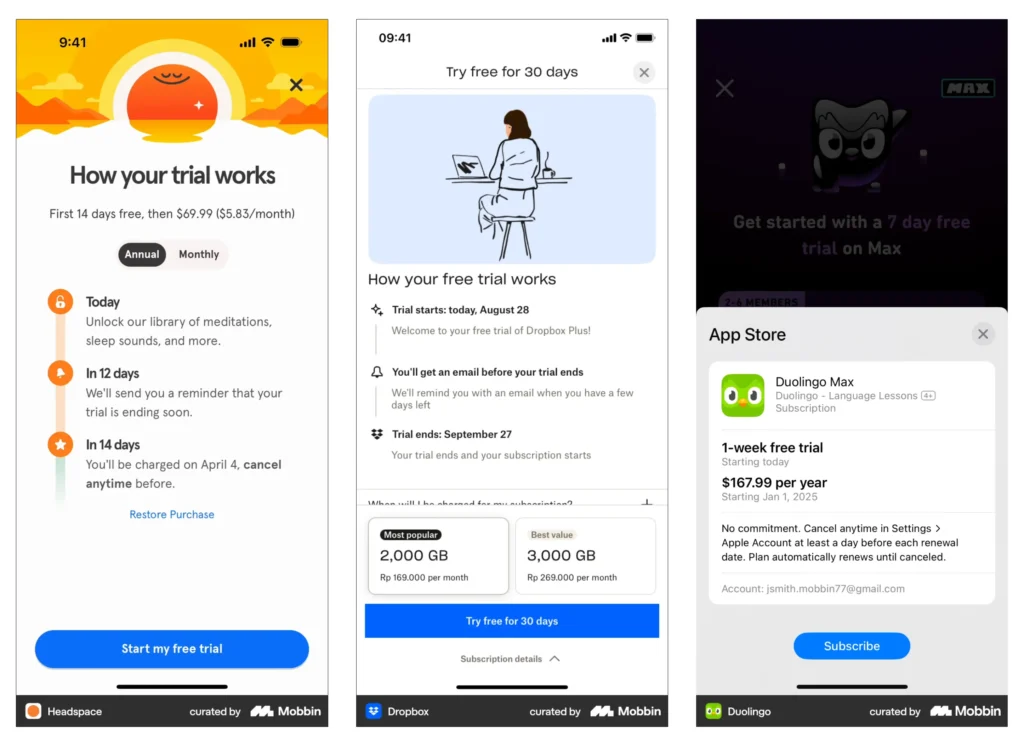
Free trials are structured conversion mechanisms that give users temporary access to premium features, letting them experience value before paying. Short trials (e.g., 7–14 days) work well for entertainment apps, while longer trials (e.g., 30 days) suit productivity or utility tools. Trials reduce friction, build habit, and increase the likelihood of conversion.
Free trials and introductory offers
Trials are often paired with introductory pricing, limited-time discounts, or bonus features to reduce hesitation at the moment of conversion. App stores support multiple introductory configurations:
- Free trials: No charge for a defined period, followed by automatic renewal.
- Pay-as-you-go offers: Discounted pricing for the first billing cycles before standard pricing applies.
- Pay-up-front discounts: Reduced price for the first subscription term (e.g., discounted annual plan).
For apps that rely on free trials, most revenue comes from a small percentage of highly engaged users, making selective engagement critical. To successfully monetize, app developers need to carefully time feature gating and prompts, ensuring users see the value before being asked to pay.
Ideal categories and industries
Free trials work best for apps that deliver ongoing, high-value functionality rather than one-off utility. They’re most effective in content-rich, streaming, fitness, education, productivity, and subscription-based tools, where continued use reinforces the decision to pay.
Subscription model in free apps
In free apps, subscriptions sit on top of a usable baseline product. Core functionality is available at no cost, while the subscription unlocks expanded value, including advanced features, unlimited access, automation, premium content, and an ad-free experience. The core idea here is to keep the free tier functional: the subscription enhances capability rather than enabling access.
This structure fundamentally shapes product strategy for free apps, as teams must carefully define the boundary between “useful” and “upgrade-worthy.” When striking this balance, apps achieve 2–5% conversion rates, with top performers generating 30% above average, primarily by retaining large user bases.
Common recurring revenue structures include:
- Freemium subscriptions: A permanent free tier with limits; the subscription removes constraints or unlocks advanced features.
- Tiered plans: Multiple subscription levels offering progressively broader access or capacity.
- Usage-based subscriptions: Free base access, with paid tiers tied to consumption thresholds (e.g., storage, processing volume).
- Hybrid models: Subscriptions combined with in-app purchases or transactional add-ons.
Subscription pricing is typically monthly or annual, with annual plans discounted to reduce churn and improve cash flow predictability. Retention is the core economic driver. Because users can fall back to the free tier after canceling, renewal depends on sustained, visible value.
In-app purchases
In-app purchases (IAPs) monetize free apps through transactional payments for discrete value (e.g., digital goods, feature access, or virtual assets) without requiring ongoing commitment. Unlike subscriptions, IAPs let users pay only when and where additional value is needed.
IAPs are most effective when embedded directly into the usage flow. In free-to-play and high-engagement apps, they often serve as the primary revenue engine when paired with strong behavioral loops. Some of the examples of IAPs include:
- Virtual currency: “gold” on Reddit, “gems” on Steam
- Virtual gifts: “coins” or “Roses” in TikTok
- Premium features: “super likes” or “boosts” in Tinder
- Gaming and gamification: extra lives or energy refills, hints, access to “locked” game levels, “ad-free” experiences, special skins and weapons
- Customization: special filters or Bitmoji outfits in Snapchat
Consumable and non-consumable in-app purchases
IAPs typically fall into two categories:
- Consumables: Items that are used up and repurchased, such as virtual currency, power-ups, extra lives, or boosts. Their performance depends on how tightly they align with core user behavior—purchases rise when consumables meaningfully enhance progress or optional advantages.
- Non-consumables: Permanent unlocks like ad removal, premium features, extra content, or lifetime upgrades. These are especially effective in utility and productivity apps, where users prefer ownership over recurring fees.
Platform rules limit IAPs to digital goods delivered inside the app, with store revenue shares influencing pricing and margin strategy.
Feature unlocking and value ladder design in IAP
Many IAP strategies are built around feature unlocking: the free tier provides baseline utility, while advanced capabilities are gated behind purchase. Effective monetization follows a value ladder:
- Free core functionality that proves reliability
- Low-friction entry purchases (e.g., ad removal, starter packs)
- Mid-tier unlocks, such as feature bundles or content expansions
- High-tier options like lifetime access or premium bundles
This structure lowers psychological risk while increasing perceived value at each step. When done well, it avoids “pay-to-win” dynamics and preserves long-term engagement among free users.
Affiliate marketing, sponsorships, and in-app branding
Affiliate partnerships and sponsorships monetize user attention without relying on generic ad networks. Instead of selling impressions, the app distributes curated offers or branded placements and earns revenue from measurable outcomes, including purchases, installs, sign-ups, and subscription activations.
This approach is inherently performance-driven. Tiered or dynamic commissions are often used to reward higher-quality traffic or premium conversions. As a result, affiliate marketing performs best in intent-focused areas such as finance, travel, fitness, and productivity.
Commission-based monetization models
Affiliate revenue is triggered by tracked conversion events, typically attributed through links, SDKs, promo codes, or server-side integrations. Common commission structures include:
- Revenue share/cost per sale (CPS): A percentage of completed transactions
- Cost per action (CPA): Payment for a defined action, such as registration or trial start
- Cost per lead (CPL): Compensation for qualified sign-ups or submitted forms
- Cost per click (CPC): Payment tied to outbound traffic volume
- Recurring commissions: Ongoing revenue share for subscription-based products
Brand alignment and trust implications
Affiliate monetization is constrained by credibility. Users perceive in-app recommendations as extensions of the in-app experience, so misaligned promotions quickly erode trust and retention.
Sustainable programs share three characteristics:
- Relevance: Offers match user intent and app context.
- Transparency: Sponsored placements are clearly disclosed.
- Native integration: Partner content is embedded into flows or content, not injected as interruptions.
In-app branding reinforces this balance. Consistent visual language, tone, and placement ensure sponsored content feels curated rather than opportunistic.
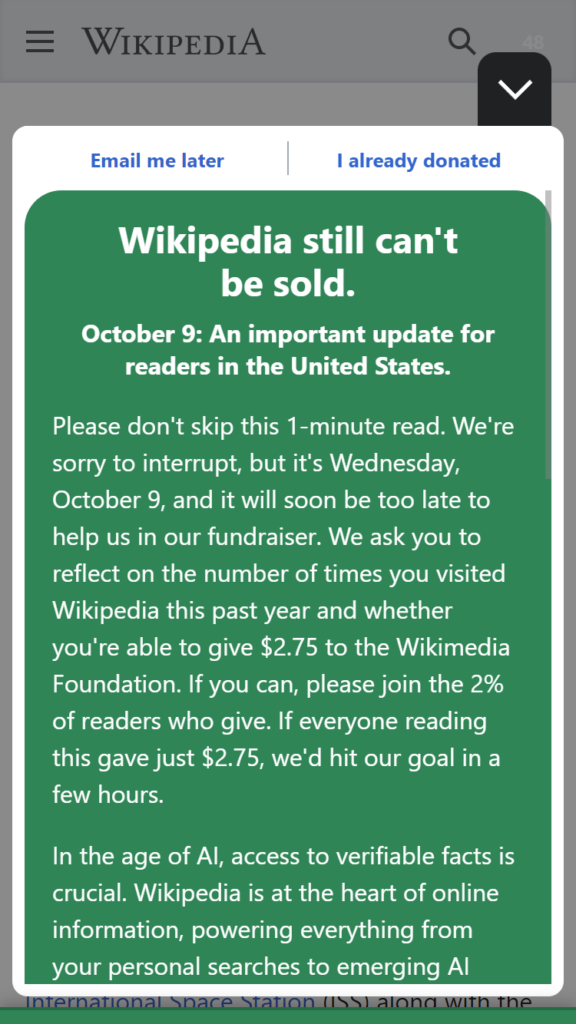
Donations
Donations are a voluntary monetization model in which users support an app without unlocking gated features in return. Revenue is driven by goodwill, perceived value, or alignment with the product’s mission rather than functional necessity.
As a free app monetization approach, donations work best for:
- Independent developers
- Open-source or community-led projects
- Content-driven products (education, journalism, podcasts)
- Niche utilities with loyal user bases
The trade-off is predictability. Donation revenue is inherently variable and depends on sustained trust, visibility, and community engagement. While it rarely scales on its own, donations can meaningfully complement other monetization models — or serve as the primary source of support in mission-driven products.
Platforms like Patreon, Buy Me a Coffee, or in-app “tip jars” via Stripe
Developers commonly implement donation infrastructure using external or hybrid payment platforms.
- Patreon enables recurring supporter memberships, typically with optional perks such as early access, bonus content, or community roles.
- Buy Me a Coffee focuses on lightweight one-time contributions with minimal friction.
- Stripe allows developers to build custom “tip jar” functionality directly into a website or web-based payment flow.
Transparency, legal, and platform-specific considerations for donations-based monetization
Donation models are tightly constrained by platform rules — especially on iOS and iPadOS. Under Apple Inc. App Store guidelines, payments that unlock digital features or content must use in-app purchases. Purely voluntary contributions, with no functional benefit attached, may use external payment methods, but only if messaging clearly avoids implying rewards, access, or advantages.
From a legal and trust perspective, clarity is extremely important. Users should understand who operates the app, how contributions are used, and whether payments are charitable or simply voluntary support. For for-profit apps, framing contributions as “support” rather than “donations” is typically more appropriate. Transparent messaging not only reduces compliance risk — it materially improves user willingness to contribute.
SDK-based monetization models
Broadly speaking, SDK-based monetization works by plugging third-party components directly into your app to handle various revenue-generating functions like. Most apps already rely on multiple SDKs to support diverse monetization strategies, such as ads, payments, analytics, and attribution.
One key distinction in the context of SDK-based monetization is between standard infrastructure (ads, subscriptions, analytics) and opaque, higher-risk SDKs — especially those that monetize device resources in the background.
Common SDK monetization patterns
- Ad serving and mediation. Ad SDKs fetch and display ads from multiple demand sources, usually via real-time auctions. Ad serving is the most common and well-understood SDK monetization model.
- Data-driven optimization. Many SDKs focus less on direct monetization and more on improving it. They collect engagement and retention data that informs ad frequency, placement, pricing, and upgrade prompts. Used well, they increase lifetime value rather than just short-term yield.
- Background resource monetization (high risk). Some SDKs generate revenue by using device resources — most often internet bandwidth or IP routing — to support third-party activity. These are sometimes marketed as “passive income” solutions, but in practice, they resemble proxy or bandwidth-sharing networks. They operate in the background and carry significantly higher legal, reputational, and platform risk.
Security, privacy, and due diligence
Every SDK expands your app’s attack surface. You remain responsible for what happens inside your product, even when functionality (or potential damage) comes from a third party.
Key risks include:
- Data over-collection, which can trigger regulatory and trust issues
- Compliance exposure, since developers remain the data controller under GDPR, CCPA/CPRA, and platform rules
- Dependency risk, where SDK updates introduce undocumented or breaking behavior
- Proxyware liability, where background traffic can violate store policies or expose users to abuse
Before integrating any monetization SDK, teams should understand exactly what data it collects, what network traffic it generates, and how it produces revenue. If the SDK cannot clearly explain how it works, that opacity is itself a risk signal.
White-label monetization
Under white-label monetization, a business licenses a pre-built product, rebrands it, and monetizes it under its own brand. White-labeling externalizes product development, with monetization occurring at the distribution layer rather than the infrastructure layer. The reseller controls branding, pricing, and customer relationships, but not the underlying codebase.
Revenue structures and pricing
White-label businesses make money through pricing arbitrage and recurring access models:
- Markup resale: Licensing the product at a wholesale rate and reselling it with a margin.
- Subscription (SaaS): Recurring monthly or annual fees, often tiered by features or usage.
- Revenue sharing: Provider and reseller share monetization outcomes (common in fintech and content platforms).
- Bundled pricing: Software packaged with onboarding, customization, or services to increase contract value and reduce churn.
In vertical markets, value-based pricing often outperforms cost-plus models. If the app drives measurable outcomes (e.g., bookings, transactions, retention), pricing can align with ROI rather than licensing cost.
Customization, differentiation, and scale
Customization is a critical competitive lever in white-label models. Without it, resellers compete solely on price. Effective differentiation typically includes:
- Visual rebranding (UI, tone, identity)
- Feature configuration by vertical
- Integration with existing systems (e.g., payments, CRMs, POS)
- Workflow alignment with client operations
Scalability depends on two layers:
- Technical: The platform must handle growth without structural rewrites.
- Commercial: Automated billing, onboarding, and support processes enable margin growth without linear cost increases.
This model is common across SaaS platforms, fintech infrastructure, content and streaming services, digital marketing tools, and industry-specific mobile apps. When paired with strong vertical positioning, disciplined pricing, and scalable operations, it can generate durable recurring revenue without assuming full responsibility for product development.
Advanced and hybrid monetization strategies
As apps mature, monetization rarely stays singular. High-performing products layer multiple revenue models into a system that adapts to user behavior, intent, and lifetime value (LTV). From a financial perspective, hybrid monetization is largely about portfolio design. Each model captures value from a different behavioral signal, allowing revenue to scale without forcing every user down the same path.
Common hybrid monetization structures
Most hybrid strategies follow behavioral segmentation logic:
- Ads + subscription (ad-supported freemium): Free users monetize through ads; paying users remove ads and unlock premium features. Common in content, gaming, and entertainment.
- Free tier + IAPs + subscription: Casual users make occasional purchases; power users subscribe for expanded limits or automation. Effective in gaming, productivity, and creative tools.
- Service fees + subscription: Marketplaces and fintech apps charge transaction fees, while subscriptions unlock lower fees, analytics, or advanced controls.
- Ads + affiliates: Broad audiences monetize via ads; high-intent users receive contextual affiliate offers. Works well in finance, travel, and aggregators.
- White-label + end-user monetization: A B2B reseller charges SaaS fees while clients monetize their own users through ads, subscriptions, or transactions.
In hybrid models, each model targets a different lever:
- Ads monetize scale
- IAPs monetize engagement
- Subscriptions monetize retention
- Service fees monetize transactions
- Affiliates monetize intent
Lifecycle-driven monetization
Mature apps often align monetization with user lifecycle and usage depth, e.g.:
- Acquisition → ad-supported access
- Early engagement → low-friction IAPs
- Habit formation → subscription prompts
- High-intent moments → service or affiliate monetization
When aligned with lifecycle stages, monetization feels progressive, and the overall UX avoids exposing users to the same disruptors.
Risks and operational trade-offs of hybrid monetization
Hybrid systems increase revenue resilience, but also complexity:
- UX clarity: Users must clearly understand what’s free, what’s paid, and what’s permanent vs. recurring. Ambiguity suppresses trust and conversion.
- Technical overhead: Multiple billing systems, SDKs, and tracking layers increase maintenance, performance risk, and attack surface.
- Internal cannibalization: Ads can weaken subscription conversion; overly generous free tiers can dilute IAP demand. Optimization must focus on total LTV, not individual channels.
- Performance impact: SDK-heavy stacks increase app size, memory usage, and battery consumption — directly affecting retention.
- Regulatory exposure: Combining ads, tracking, billing, and attribution compounds privacy and consent requirements.
Strategic discipline
More monetization levers don’t automatically mean more revenue. The strongest hybrid systems are deliberately constrained, prioritizing:
- Clear value hierarchy
- Predictable upgrade logic
- Controlled ad frequency
- Cohort-based experimentation
- LTV-driven decisions
In advanced app economics, monetization is an adaptive system. Successful apps don’t simply add revenue channels — instead, they integrate monetization into product architecture, lifecycle analytics, and user retention strategy.
Practical examples: making money from free apps
High-level monetization advice is easy to find. Realistic expectations are harder. To ground this section in reality, the examples below combine ad revenue benchmarks from Google AdSense with subscription performance data published by RevenueCat.
Note that our goal here isn’t to promise outcomes, but rather to show what typical economics actually look like at different scales.
Example 1: In-app advertising (RPM benchmarks)
Advertising revenue is usually expressed as RPM (revenue per thousand impressions):
RPM = (estimated earnings ÷ impressions) × 1,000
RPM reflects realized revenue, not advertiser bids or guaranteed payouts. For mobile apps, commonly observed ranges are:
- General consumer apps: $1–$5 RPM
- Low-value geographies: under $2
- High-intent niches (finance, insurance, B2B): $8–$20+
- Rewarded video (especially in games): typically higher than banners
With this in mind, $1–$5 RPM is a realistic baseline for most mixed-geography consumer apps. Now, let’s consider a scenario where ads are your only monetization model.
An ads-only app with 100,000 monthly active users, serving an average of eight ad impressions per user per month, would generate roughly 800,000 impressions monthly. At an RPM of $3, this translates into approximately $2,400 in monthly ad revenue. To reach $10,000 per month at the same RPM, the app would need to generate around 3.3 million impressions, underscoring how strongly ad-based monetization depends on scale and session volume.
Example 2: Subscription benchmarks (conversion and pricing reality)
Subscription revenue depends on four core variables: download volume, conversion from downloads to trials, conversion from trials to paid, and retention duration.
Based on the 2026 benchmarks published by RevenueCat:
- Median download → trial conversion is around 6%, while top-performing (top 10%) apps exceed 20%.
- Trial → paid conversion varies by category, with travel apps (~49%) and health & fitness (~40%) among the strongest performers.
- Nearly 30% of annual subscriptions cancel within the first month, making early retention critical.
- Median revenue per install (RPI) across apps is approximately $0.31, rising to about $0.63 for AI and health or fitness apps.
These figures enable modeling realistic break-even scenarios for subscriptions. For example, assume an app with:
- $75,000 in development cost
- $4,000/month in infrastructure and support expenses
- A $12/month subscription price
- Net revenue of approximately $8.40 per subscriber after a 30% store fee
To cover ongoing operating costs, the app would need roughly 476 active subscribers. Recovering the development cost over 12 months adds another 744 subscribers, bringing the total required paying base to about 1,220 active subscribers.
Now, let’s reverse-engineer the acquisition side. With a 6% conversion from downloads to trials and a 40% conversion from trials to paid, the effective paid conversion rate from installs is 2.4%. At that rate, reaching 1,220 subscribers would require approximately 50,800 total downloads.
This example shows why subscription monetization hinges on conversion efficiency and retention, not just pricing. Even modest improvements at each step of the funnel can dramatically affect revenue outcomes.
Differences between iOS and Android app monetization
Platform economics: fees and payment rails
Both iOS and Android apply a 30% revenue share to paid apps, in-app purchases, and subscriptions, with reduced rates for smaller developers. On both platforms, apps earning under $1M annually qualify for a 15% commission, which significantly improves early-stage unit economics.
Where they diverge is in the treatment and timing of subscriptions. On iOS, subscriptions drop from 30% to 15% only after a subscriber’s first year, which rewards long retention. On Android, subscriptions are 15% from day one, and Google also offers category-specific programs (such as media partnerships) that can further reduce effective fees.
The implication is straightforward: long-lived subscriptions favor iOS over time, while subscription-heavy or sub-$1M apps often see lower blended fees on Android earlier in their lifecycle.
Bypassing store fees: web billing
High-revenue apps increasingly route payments through the web to avoid in-app commissions. Companies like Spotify and Headspace direct users to browser checkout, typically using providers such as Stripe or merchant-of-record platforms.
This approach makes sense when the lifetime value is high, and the app controls its own traffic. The trade-off is conversion friction: leaving the native flow can reduce completion rates and must be handled carefully to remain compliant with platform policies.
Revenue performance by platform
In practice, iOS monetizes per user better, while Android excels at monetizing at scale.
iOS users tend to generate higher ARPU (average revenue per user) and ARPPU (average revenue per paying user), particularly for subscriptions and premium purchases. Android, by contrast, delivers larger global install volume, which benefits ad-driven, freemium, and mass-market gaming apps. Android users are also generally more tolerant of rewarded and interstitial ads, while aggressive ad loads on iOS often hurt retention.
Strategic takeaways:
- Prioritize iOS for subscription-led or high-value IAP models where revenue density and payback speed matter.
- Prioritize Android for ads, freemium, or scale-dependent models where reach and volume drive returns.
- For lean teams, Android can also serve as a cost-efficient testing ground before optimizing monetization for iOS.
How to choose the right monetization strategy: 4 actionable recommendations
Choosing a monetization strategy is an economic design decision that comes from structured analysis. It defines how value is captured, how users experience the product, and whether growth compounds over time.
1. Start with users and category economics
Monetization begins with clarity about who the user is and what they expect to pay for. Segment users by behavior and motivation first, not just demographics. In B2C, focus on emotional drivers, habit strength, and impulse vs. considered purchases. In B2B, segmentation should reflect company size, budget ownership, and procurement friction.
Category norms matter because they set pricing expectations:
- Productivity and business apps favor subscriptions
- Games monetize through in-app purchases and cosmetics
- Content apps often combine ads and subscriptions
- Utilities lean toward one-time unlocks or lightweight subscriptions
- Finance and enterprise apps support higher ARPU but low ad tolerance
Violating category expectations (for example, aggressive ads in a finance app) usually erodes trust faster than it increases revenue.
To validate assumptions, rely on lightweight but real research: user interviews, willingness-to-pay surveys, review analysis, and persona mapping based on actual usage contexts.
2. Align monetization with user experience
Revenue mechanics must feel fair and contextual. Good monetization follows a few core rules:
- Pricing and renewal terms are explicit and easy to understand
- Users experience real value before hitting a paywall
- Upgrade prompts appear at moments of intent, not randomly
- Scarcity and urgency are used sparingly and truthfully
- Ads (if used) respect core workflows and natural breaks
3. Benchmark competitors, but don’t mindlessly follow them
Competitive analysis reduces guesswork but shouldn’t dictate strategy. Review 5–10 direct competitors to understand:
- Primary revenue model and pricing bands
- Trial structure and feature gating depth
- Paywall placement and ad density
Pay special attention to user sentiment in app store reviews. Complaints about ads, hidden renewals, or unfair restrictions often reveal monetization mistakes worth avoiding.
4. Set revenue goals and time monetization deliberately
Monetization timing should reflect both financial constraints and growth goals. Define a small set of metrics up front:
- Target ARPU and LTV
- Acceptable ratio between customer lifetime value and customer acquisition cost (i.e., LTV/CAC Ratio)
- Break-even timeline and minimum monthly revenue
Common timing patterns include:
- Subscription-first with trials during onboarding
- Value-triggered paywalls after meaningful actions
- Ads introduced only after reaching a sufficient scale
- Hybrid sequencing (subscriptions first, ads later for free users)
Step-by-step monetization process
An effective app monetization strategy requires a methodical, step-by-step approach that moves from financial planning to continuous optimization. The following steps provide a high-level framework for defining, implementing, and scaling your revenue model.
- Quantify your cost base: Calculate build cost, monthly burn, variable expenses, and target CAC to define a clear break-even threshold.
- Define the primary revenue driver: Choose one dominant model (subscription, IAP, ads, or paid access). Validate hybrid approaches later.
- Select platform monetization focus (iOS vs Android): Compare ARPU, audience geography, payment behavior, and commission dynamics to sequence platforms intelligently.
- Embed monetization into the product flow: Place paywalls, upsells, and ads at moments of peak perceived value.
- Implement billing infrastructure: Use native in-app billing with proper validation, lifecycle handling, and (if needed) compliant web billing for flexibility.
- Instrument full-funnel analytics: Track paywall exposure through renewal and churn, alongside ARPU, LTV, CAC, and payback period.
- Run controlled pricing experiments: Test one variable at a time (trial length, pricing tiers, discounts, ad load) and measure impact on retention and revenue quality.
- Validate break-even math: Use real ARPPU and cost data to confirm whether conversion and volume can sustain operations.
- Optimize retention before scaling spend: Improve activation, feature adoption, and cancellation recovery before increasing acquisition budgets.
- Layer secondary monetization streams: Add annual plans, ad-supported tiers, consumables, or regional pricing once the core model is stable.
- Establish governance and compliance: Ensure transparent pricing, easy cancellation, data privacy compliance, and adherence to platform policies.
Optimizing and scaling monetization
Monetization is an iterative system that evolves together with your app. After launch, revenue performance depends on how systematically monetization is measured, tested, and refined across the user lifecycle.
Track the metrics that actually govern revenue
Optimization starts with disciplined instrumentation. Focus on metrics that explain why revenue grows or stalls.
- Core economics:
- ARPU (average revenue per user): total revenue ÷ total users
- ARPPU (average revenue per paying user): revenue ÷ paying users
- LTV (lifetime value): projected revenue per user over their lifecycle
- Conversion rate (CVR): % of users completing a monetized action
- CPI (cost per install): acquisition cost per user
- ROI (return on investment): revenue relative to acquisition and operating costs
- Subscriptions:
- MRR (monthly recurring revenue): predictable monthly subscription revenue
- Churn rate: % of subscribers lost in a given period
- NRR (net revenue retention): revenue retained from existing customers after churn and upgrades
- Ad-supported apps:
- eCPM (effective cost per mille): revenue per 1,000 ad impressions
- ARPDAU (average revenue per daily active user): revenue generated per active user per day
- Fill rate: % of available ad inventory actually sold
- Engagement:
- DAU/MAU (daily active users ÷ monthly active users * 100%): stickiness ratio
- Session duration: average time spent per session
- Purchase frequency: number of purchases per user
- D1/D7/D30 retention: % of users returning on day 1, day 7, and day 30 after install
Retention and monetization are mathematically linked: improving Day-30 retention typically increases LTV more than marginal changes in pricing. Tracking these metrics by cohort (acquisition channel, geography, or device) exposes efficiency gaps.
Use controlled experiments to remove guesswork
Use A/B testing or multivariate testing (MVT) to test monetization elements in context:
- Paywalls: layout, messaging, trial length, default plan
- Pricing: elasticity, discount framing, bundles, subscription cadence
- Ads: format, frequency, placement, reward value
- Feature gating: what’s free vs. paid, and when paywalls appear
When running experiments, remember to test one variable at a time, define success metrics in advance, segment by cohort, and optimize for long-term LTV.
Optimize for retention before revenue intensity
Retention is the primary growth lever for most apps. Monetization that increases ARPU but shortens user lifespan destroys value.
- Delay aggressive monetization until the core value is demonstrated
- Use contextual and rewarded monetization to preserve fairness
- Segment intensity by user value (power users, non-payers, high-LTV cohorts)
- Reduce churn with lifecycle messaging, renewal nudges, and usage-based upgrades
Even modest retention gains compound revenue because acquisition costs remain fixed while the user lifespan extends.
Scale monetization as a portfolio, not a tactic
As the user base grows, monetization shifts from conversion tuning to revenue system design.
- Revenue diversification: hybrid ads + subscriptions, tiered IAPs, bundles
- Yield optimization: ad mediation to maximize eCPM and fill rate
- Value ladders: entry-level → mid-tier → premium packages
- Personalization: behavior- and geography-based offers, ad suppression for subscribers
- Unit economics discipline: scale acquisition only when LTV:CAC is sustainably strong (≈3:1+)
Throughout scaling, UX remains a constraint. Increasing ad density or friction may lift short-term revenue but often damages retention, ratings, and long-term enterprise value.
Trends in how free apps make money
In 2026, free app monetization is less about choosing a single model and more about orchestrating multiple revenue layers intelligently. Pricing strategy, hybrid structures, AI personalization, and privacy-conscious design are converging into sophisticated, sustainable revenue architectures.
Growth of hybrid monetization
Non-gaming apps historically leaned on subscriptions, while gaming favored in-app purchases (IAP). That distinction is fading. Today, apps increasingly combine multiple layers, such as:
- Subscriptions + IAP
- Subscriptions + rewarded ads
- Freemium + consumables
- Subscription + digital or physical add-ons
- AI-driven usage-based tiers
The rationale is simple: different user cohorts have different willingness to pay. High-intent users often subscribe, engaged but price-sensitive users respond to ads, and power users buy premium add-ons. Productivity, wellness, education, and creator-focused apps are now adopting these layered models, increasing revenue stability, cohort-level flexibility, and overall ARPU.
Privacy-first data monetization
Changes in platform privacy, like Apple’s App Tracking Transparency and tightened Android rules, are shifting monetization away from cross-app surveillance. The focus is now on first-party intelligence and consent-driven personalization. Modern apps monetize:
- Behavioral signals
- Engagement depth
- Intent-based triggers
Trust is now a direct driver of lifetime value. Apps that handle data transparently and avoid perceived exploitation see higher retention and monetization efficiency.
Gamification of ads and purchases
Apps increasingly embed revenue into progression rather than interruption. Gamified mechanics include:
- Rewarded video ads
- Experience point (XP) systems and streak-based unlocks
- Limited-time purchase boosts
- Milestone-triggered upgrade prompts
- Progress bars tied to premium unlocks
Rewarded ads and milestone triggers encourage opt-in engagement, increasing session length and conversion while protecting retention. Gamification transforms monetization from transactional to participatory, making revenue feel like part of the user experience.
AI-driven monetization personalization
AI is emerging as the control layer for modern monetization. Key applications include:
- Dynamic pricing based on engagement
- Predictive churn detection
- Contextual paywall timing
- Personalized offers by region or cohort
- Intelligent ad frequency optimization
AI enables apps to decide when to present offers, which plans to highlight, which discounts to deploy, and when to suppress ads. Predictive LTV modeling segments high-value users early, allowing differentiated monetization intensity from day one. Data-driven personalization consistently outperforms static or rule-based approaches in both revenue efficiency and retention.
Common mistakes in free app monetization
Even well-designed apps can fail to monetize effectively if revenue mechanics clash with user experience. The errors below consistently reduce retention, damage trust, and cap long-term lifetime value. Understanding these pitfalls and applying targeted mitigations is essential for sustainable monetization.
| Common mistake | Symptoms & examples | Consequences | Mitigation & best practices |
| Over-monetization & user fatigue | Excessive interstitials, forced ads, repetitive subscription prompts, and early paywalls | Ad blindness, reduced retention, accelerated churn, emotional fatigue | Reduce ad frequency, use rewarded ads, introduce monetization at natural friction points, optimize retention first |
| Monetizing before delivering core value | Paywalls on first launch, gating primary features, and upsells before product experience. | Low conversion, high churn, frustrated users | Freemium core utility, soft paywalls, starter packs, microtransactions; monetize after value is proven |
| Ignoring retention and LTV | Focus on early ARPU or installs, neglect Day-1/7/30 retention and cohort LTV | High churn, unstable revenue, poor store ratings, high CAC | Value-first onboarding, contextual monetization, segment by engagement, adjust intensity by predicted LTV, and continuous retention analytics |
| Damaging trust | Hidden renewals, misleading trials, artificial scarcity, exploitative ads, “pay-to-win” mechanics | Negative reviews, high uninstall rate, regulatory scrutiny, long-term brand damage | Transparent pricing & renewals, ethical scarcity, clear value exchange, easy subscription management, and regulatory compliance |
Conclusion
Free apps generate revenue through a deliberate monetization strategy. Sustainable performance depends on aligning the revenue model with user intent, delivering clear value before introducing friction, and continuously optimizing pricing, placement, and retention. Execution quality determines profitability.
As hybrid monetization, privacy constraints, and AI-driven personalization reshape the market, long-term success increasingly depends on trust and lifetime value. Apps that balance revenue generation with user experience build stronger retention, higher ARPU, and more defensible growth over time.
Frequently asked questions about how free apps make money
Are free apps actually free for developers?
No. Even a “free” app costs money to build and maintain, including development, design, backend infrastructure, SDK integrations, updates, and marketing. App stores also take 15–30% commission on in-app purchases and subscriptions. Free apps simply shift revenue from upfront purchases to indirect models such as ads, subscriptions, and in-app purchases.
What is the most profitable free app monetization model?
There’s no one-size-fits-all model. Profitability depends on category, audience, and scale. Typically:
- Subscriptions: highest lifetime value when retention is strong
- Hybrid models (subscriptions + ads + IAPs): maximize revenue diversification
- In-app purchases (IAPs): dominant in gaming for power-user spend
- Ad-based models: scale with volume, efficient for casual or utility apps
The key is to align the strategy with user intent and continuously optimize it.
How long does it take for a free app to make money?
It varies with acquisition strategy, retention, and monetization timing. Some apps earn ad revenue immediately, but meaningful, sustainable income usually takes:
- 3–6 months for data-driven optimization
- 6–18 months to reach recurring revenue
Subscription-based apps may take longer due to retention compounding, but apps prioritizing early retention reach profitability faster.
Can small or no-code/low-code apps generate revenue?
Yes, but generally on a smaller scale. Lower development costs reduce break-even thresholds, but advanced personalization and scaling may be limited. No-code apps can be profitable for niche audiences, micro-SaaS offerings, or simple utilities, especially when backed by strong distribution or community support.
Do free apps make more money on iOS or Android?
It depends on the model:
- iOS: higher ARPU, stronger subscription conversion, users are more willing to pay
- Android: larger global base, stronger ad revenue potential, higher install volume
In practice, subscription apps often perform better on iOS, while ad-supported apps scale more efficiently on Android. Most mature apps optimize monetization on a per-platform basis rather than applying the same strategy everywhere.