Live social maps are one of the more intriguing categories in consumer app development. On the surface, this category is primarily represented by location-sharing features built into larger social apps, like Snap Map in Snapchat or Live Location in WhatsApp. Niche standalone apps like Swarm by Foursquare also have their own followings, yet none has emerged as the category’s clear, mainstream leader in its own right.
This landscape leaves plenty of room for companies looking to rethink how people discover what is happening nearby, connect with friends, and turn online interactions into real-world meetups.
That is one reason our recent engagement with GeoTap was particularly exciting. Another reason was the opportunity to work on sophisticated geospatial systems, privacy-first location sharing, and real-time social experiences.
In this article, we will explore our journey helping transform the product from a founder-led vision and Flutter prototype into an App Store-ready application. Along the way, we will share engineering decisions and the rationale behind them that may prove valuable for companies planning to launch mobile applications in 2026 and beyond.
Meet GeoTap: a map for what is happening now
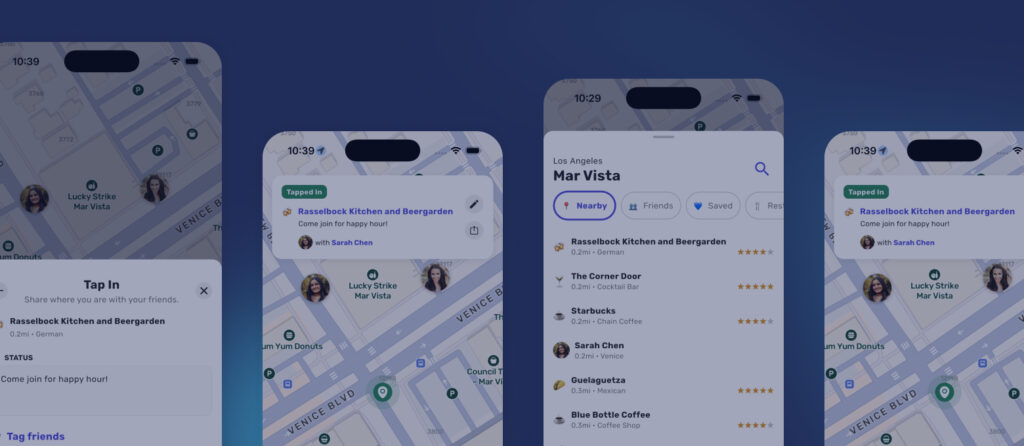
Unlike traditional social apps that revolve around feeds and past events, GeoTap focuses on what is happening at the moment. Its core loop centers on presence and discovery: friends see where their circle currently is, check in at the places they visit through the app’s tap-in feature, and surface nearby spots worth stopping by.
Every part of that experience runs through user-controlled privacy settings, so visibility is a choice rather than a default. Whether someone is out for coffee, at the beach, or meeting up with friends, the app is built around present-moment context rather than a feed of things that already happened.
Pulling that off requires much more than displaying pins on a map. Every interaction depends on accurate location data, real-time updates, reliable notifications, privacy-aware visibility rules, and backend services that work together seamlessly.
The challenge: turning a prototype into a market-ready product
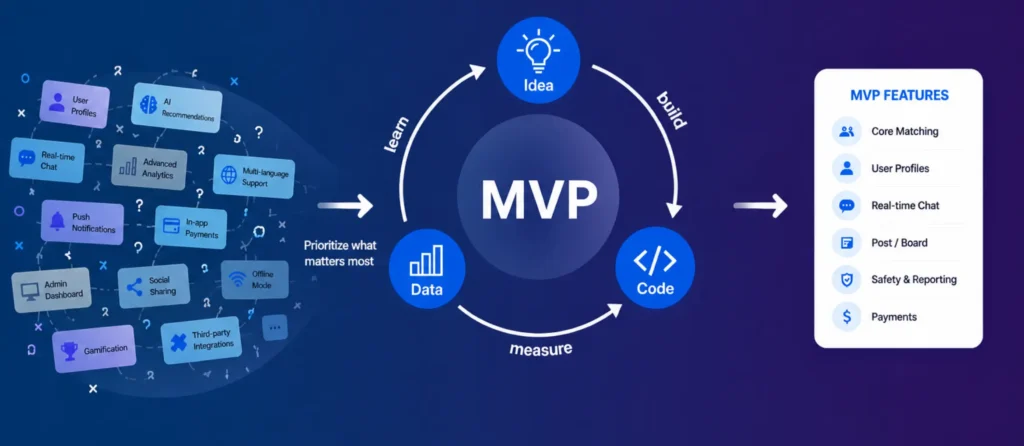
When GeoTap approached AgileEngine, the company already had a founder-defined product vision, design direction, and a Flutter prototype that demonstrated the core user experience. The engagement focused on preparing that prototype for a successful App Store launch while keeping the engineering effort aligned with the company’s stage. Like many early-stage products, the goal was to validate the concept with real users before making larger engineering investments.
Core to that effort was building the production backend, cloud infrastructure, and the platform services needed to support the app’s social and geospatial experiences. The project also included integrating third-party services, preparing the application for production, and providing the quality assurance, accessibility improvements, and release hardening required for an App Store launch.
We approached the engagement from two complementary angles. First, we assembled a nearshore engineering team in LATAM, giving the client access to experienced engineers at a lower cost than building an equivalent in-house team. Second, our AI augmentation playbook helped accelerate implementation while maintaining the quality standards expected of a high-stakes production app.
Increase the ROI of software projects by over 3x with AI-augmented remote development and design solutions tailored to your business goals.
Book a consultationBuilding the backend and infrastructure
AgileEngine’s team built GeoTap’s backend and infrastructure from the ground up, supporting authentication, user profiles, file storage, friend interactions, and the tap-in system. Our work also enabled location tracking, place discovery through a Foursquare integration, and the notification infrastructure powering the app’s core interactions. A few engineering decisions behind that work stand out.
- A monorepo for rapid development. The team set the project up as a Turborepo-managed monorepo, using pnpm workspaces to share code between the backend service and its supporting packages. For a small, fast-moving team, one repository with clear boundaries beats coordinating changes across several.
- PostGIS for geospatial queries. Much of GeoTap’s value comes from proximity and place logic, so the database runs PostgreSQL with the PostGIS extension, paired with Prisma as the object-relational mapper (ORM). PostGIS handles geospatial queries natively instead of bolting location math onto a general-purpose database.
- A self-hosted database and cache, by design. Rather than defaulting to managed services like Amazon RDS, the team self-hosted PostgreSQL and Redis through Docker Compose on the application’s EC2 (Amazon Elastic Compute Cloud) instances. At our client’s current scale, this keeps infrastructure costs down without giving up reliability.
- BullMQ for background jobs. Notifications, one of the app’s core loops, run asynchronously through BullMQ, a Redis-backed job queue. Tap-in events, friend requests, and tagging all trigger notification jobs without blocking the request that caused them, keeping the app responsive under load.
- JWT with server-side revocation. Authentication uses JSON Web Tokens (JWT) for short-lived access, paired with refresh tokens stored server-side and hashed. Each refresh token is tied to a device, IP address, and user agent. That link lets a user log out a single device or every device at once, a detail that matters on a social app people install on more than one phone.
- Infrastructure as code. AWS infrastructure, including EC2, S3 (Amazon Simple Storage Service), CloudWatch, and networking, is defined in Terraform rather than configured by hand. Cloudflare sits in front of production traffic for DDoS protection and a hidden origin IP. Together, they give the team a repeatable, auditable way to stand up or change environments.
- A test pipeline built for confidence. Every pull request runs a three-layer automated test suite (unit, functional, and end-to-end) against real PostgreSQL, PostGIS, and Redis service containers rather than mocks alone.
- Keeping the mobile client in sync. A GitHub Action regenerates the Flutter Dart client from the backend’s OpenAPI specification after every merge to the main branch. That step catches any drift between the application programming interface (API) and the mobile app before it reaches users, without relying on someone remembering to update the client by hand.
Preparing for App Store launch
Getting an app onto the App Store takes more than working features. AgileEngine’s team spent the final stretch of the engagement on quality, accessibility, and security, the areas Apple’s review process and real users tend to care about most.
Aligning with accessibility standards
AgileEngine supported the accessibility efforts needed for pre-launch readiness, aligning the app with the Web Content Accessibility Guidelines (WCAG) 2.1 AA and covering VoiceOver support, labeling, focus order, contrast, and Dynamic Type.
Strengthening application security
Security work covered session and token handling, role-based permissions, rate limiting, transport security through Transport Layer Security (TLS), encryption at rest, and abuse controls on public-facing endpoints like the feed and nearby search.
Ensuring release quality
On the QA side, the team maintained a versioned Postman collection covering every backend module. The release process also shifted toward fewer, higher-quality releases backed by real-device testing, which reduced regressions during the beta period ahead of App Store launch.
Our AI augmentation playbook
AgileEngine’s engineers used Claude Code throughout the engagement, applying it to both feature planning and implementation.
The repository included a playbook describing the project’s engineering conventions and a standard workflow for implementing new features: schema, endpoints, tests, Postman updates, and finally a check against the OpenAPI specification. It also defined how AI should be used throughout the project through a set of guardrails.
Claude Code could not skip the project’s three-layer test requirement, had to keep the Postman collection up to date with every new endpoint, and was required to ask before making ambiguous product decisions. It also never performed destructive Git operations on its own.
The result was an AI workflow that accelerated repetitive, well-defined tasks while preserving the team’s engineering standards. Product decisions, architectural trade-offs, and other judgment calls remained firmly in the hands of experienced engineers.
Landing a successful App Store launch in under six months
Just under six months after the engagement began, GeoTap was ready to launch. The application was approved by Apple and went live on the App Store in July 2026, marking the successful completion of the initial development phase.
Following the release, AgileEngine transitioned into an ongoing time-and-materials engagement, providing post-launch bug fixes, updates to the backend and mobile application, and continued accessibility improvements as the product evolves.
Closing thoughts on the project and what it means for teams building new apps in 2026
GeoTap’s engagement points to a broader lesson: the right technical approach depends on a company’s product and business phase, not a fixed playbook. A monorepo and a self-hosted database made sense for a small, fast-moving team validating a new product; those same choices might look different at a later stage or larger scale. Layering AI-assisted development on top, with clear guardrails in place, gave the team an additional way to move faster without sacrificing quality.
Have a similar challenge ahead? Consult our experts to explore which architectural approaches, technology stack, and development methodologies are the right fit for your industry, goals, and business context.