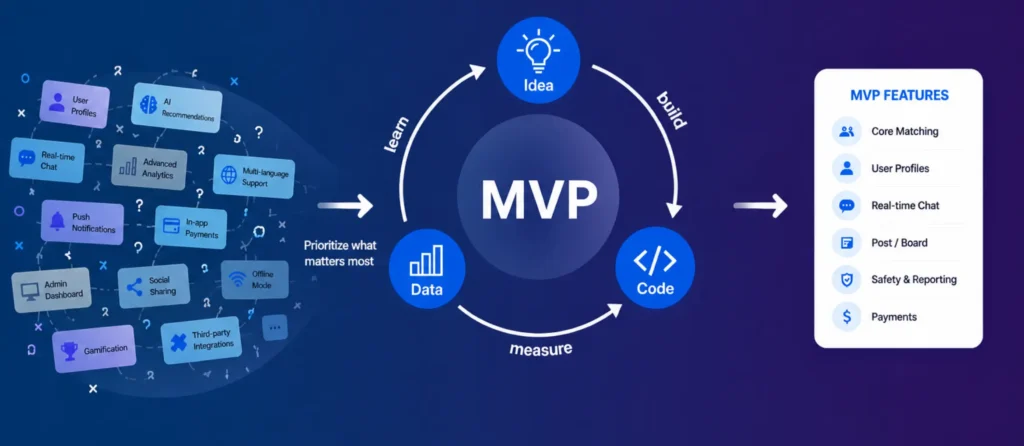
If you have spent enough time creating software products, you know the default playbook: start with a lean Minimum Viable Product (MVP) and scale from there. We have all read the stories. Dropbox launched with a three-minute explainer video instead of actual, working file-sync functionality. Instagram started as a photo app with filters. Spotify, Uber, Airbnb, and Buffer all followed the same route, each launching as an aggressively lean MVP.
And yet, despite lean MVP being pretty much the mantra of product development, many companies still struggle with over-scoping before launch. Sounds familiar? According to an Atlanta Ventures partner, roughly 80% of the initial features a team builds end up wasted, since most feature ideas only prove their worth once real paying customers start using them.
In one of our recent client engagements, an online marketplace company approached us with an ambitious product vision totaling more than 200 features. This article looks at how we narrowed that wishlist into an MVP that we could ship within three months while still covering every core user need. Along the way, we will examine why companies over-scope, when a larger scope actually makes sense, and how scope management is changing in the age of AI.
Why do companies over-scope?
No founder sets out to build a bloated product — getting there usually happens one reasonable-looking decision at a time. A high-value customer asks for a reporting feature. A pilot account needs a specific integration. A competitor ships an AI assistant, so the roadmap gets one too. None of these calls looks wrong in isolation. Trouble starts when a string of locally sensible additions adds up to a product nobody can describe in one sentence anymore.
A few forces tend to drive that drift:
- The “kitchen sink” sales trap. Sales closes an early landmark deal by promising a client a custom feature. Other clients ask for their own. Over time, the roadmap stops reflecting a coherent product vision and becomes a checklist of one-off requests.
- Fear of market rejection. Founders worry that an excessively lean product will look unfinished or undermine the brand. That anxiety drives repeated delays to add “just one more feature,” which pushes the launch date further out each time.
- The “product committee” effect. When Marketing, Legal, Security, and Design all have equal say without a technical gatekeeper, each function pushes its own requirements into the build. The result is a product shaped by committee rather than by user need.
- Funding pressure. Large funding rounds give companies the resources to quickly scale engineering headcount. Startup teams can then feel compelled to justify that investment with ambitious, broad systems rather than a focused MVP.
- Feature-for-feature competition. New companies entering a market try to match a mature competitor point by point instead of identifying the specific area where they need to win first.
- Sunk cost. When a feature already has weeks or months of design, research, and development behind it, teams sometimes keep building it even after it no longer makes sense, simply because of the investment already made.
- AI makes development feel cheap. Modern AI coding tools and no-code platforms have made building new features fast and low-effort. But the cost of maintaining, documenting, testing, and supporting that feature does not shrink to match. That gap between build cost and everything that follows is easy to miss until the backlog catches up.
When a larger scope is justified
A lean MVP is usually the right strategy, but your definition of “minimum” will depend on the specific problems your team is solving. Some products face regulatory, operational, or competitive constraints that make a broader launch scope unavoidable. In those cases, the challenge is not resisting feature creep. It is delivering the minimum level of functionality needed for the product to be viable.
- Regulated industries. In fintech, medtech, and govtech, capabilities such as encryption, multi-factor authentication, audit trails, fraud detection, and compliance reporting are baseline expectations rather than features that can wait until a later release.
- New alternatives to legacy enterprise systems. Companies building alternatives to platforms like SAP or Salesforce often need broad functional coverage from day one. If a product cannot support the core workflows enterprise buyers already rely on, it may never make it past vendor evaluation, regardless of how compelling its differentiators are.
- Entering a mature, commodity market. Users expect table-stakes functionality from products like email clients, e-commerce platforms, project management software, and video conferencing tools. A product that feels obviously incomplete may never get a second chance.
- High-stakes launches with brand risk. Established companies face greater reputational exposure from an unpolished launch, which raises the bar for what “minimum” means.
- Safety-critical infrastructure. In industries such as aerospace, power grid management, autonomous driving, and high-value logistics, operational safeguards, reliability, and compliance cannot be deferred until after launch.
Our client, a marketplace connecting homeowners with vetted local contractors, entered a mature market with well-established user expectations on both sides of the platform. Homeowners required sufficient functionality to trust and use the service, while contractors needed the tools to manage jobs and grow their business. That meant a barebones MVP was never a realistic option.
Even so, the original scope went far beyond what the first release required. Our goal was to narrow it dramatically while ensuring the platform could evolve in three important ways: support increasingly sophisticated capabilities (including AI-driven functionality), scale with user growth, and expand into new geographic markets without placing unnecessary strain on the client’s in-house engineering team.
Moving from wishlist to roadmap: how we approached discovery and inception
We began with a three-week discovery and inception phase, working alongside the client to rebuild the MVP definition from scratch. Rather than treating the existing backlog as the starting point, we challenged every previously assumed requirement. No feature carried over simply because it had already been documented or discussed. Each one had to justify its place in the first release based on customer value, technical complexity, and a realistic market timeline.
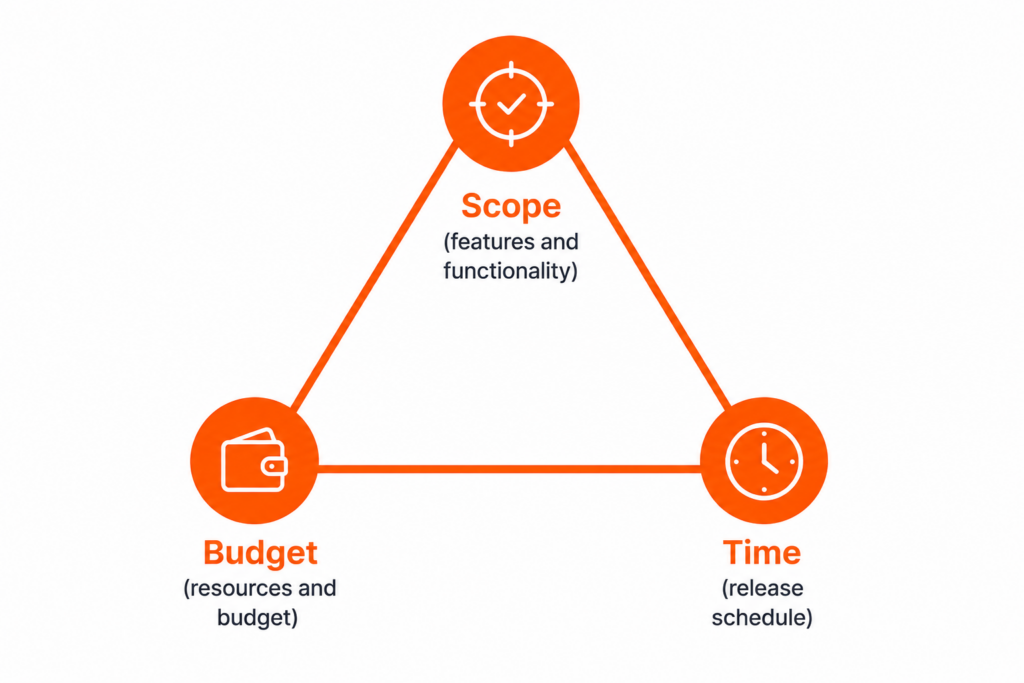
Throughout the process, we anchored prioritization around a simple principle: the iron triangle of product delivery. With the launch timeline and budget fixed, scope became the only variable. Instead of asking whether a feature would be valuable eventually, we asked whether it was valuable enough to earn a place in the MVP. That shift turned prioritization from an open-ended debate into a series of explicit tradeoffs.
To keep those decisions transparent, the discovery phase produced two working artifacts that guided the entire engagement:
- A living product specification, continuously refined as business and technical decisions were validated.
- A four-tier feature inventory, classifying every requirement as in scope, out of scope, deferred, or future, ensuring that every feature had a documented rationale rather than simply disappearing from the roadmap.
By the end of discovery, what initially looked like a six-to-nine-month engineering effort had been restructured into a clearly bounded three-month MVP roadmap without compromising the platform’s long-term direction.
That roadmap included:
- Full-stack MVP functionality, including authentication and onboarding, the homeowner-contractor matching engine, billing, notifications, and administrative tooling.
- AI-ready cloud architecture design and Amazon Web Services (AWS) infrastructure, with the production environment provisioned within the first 30 days.
- Low- and high-fidelity user experience (UX) wireframes spanning both mobile and desktop experiences.
- An end-to-end product specification covering homeowner workflows, contractor workflows, the administrative portal, and the platform’s core business logic.
Cut software engineering and design costs by over 50% by engaging thoroughly vetted experts across 15+ global hubs.
Talk to our expertsArchitecting the product for future growth
Reducing the MVP scope did not mean limiting the platform’s long-term potential. Alongside the features required for launch, we focused on architectural decisions that would allow the product to evolve without major redesigns as the business grew.
Growth-ready cloud architecture
Our team built the platform entirely on managed AWS services using a fully serverless, event-driven architecture that scales automatically with demand. This approach keeps the platform responsive during traffic spikes and scales back efficiently during quieter periods, eliminating the need for manual capacity planning and server management.
It also supports rapid business expansion. New geographic markets can be launched through configuration rather than infrastructure changes, allowing administrators to define ZIP-code coverage, business hours, service areas, and other market-specific settings without provisioning additional cloud resources.
Vendor-agnostic AI capabilities
AI sits at the core of the product experience. Homeowners describe their issues in natural language, and AI categorizes each request, matches it to the appropriate contractor pool, suggests price estimates, and generates contractor-facing summaries, removing personally identifiable information.
At the same time, we deliberately avoided coupling those capabilities to a single model provider. AI workflows are isolated behind a lightweight internal service layer running on AWS Lambda, making the platform provider-agnostic. This approach prevents vendor lock-in, allowing the client to adopt new model providers or more capable future models.
Fast, efficient, and fair matching
For marketplaces, the matching engine largely determines the quality of the customer experience. We designed it to balance three priorities: responsiveness, efficient resource utilization, and long-term marketplace quality.
The engine we implemented enables real-time responsiveness through immediate contractor dispatch while also supporting matching windows of up to 60 minutes without consuming additional compute resources.
The allocation model also evolves alongside the marketplace. Newly launched markets begin with a round-robin distribution model that gives contractors equal access to new opportunities while supply and demand stabilize. After 90 days, the platform transitions to a merit-based ranking model, rewarding quality while maintaining a healthy marketplace.
Security built in from day one
Scalable infrastructure and a great customer experience are only part of the foundation for growth. Preventing security vulnerabilities and costly rework later in the product lifecycle is just as important, which is why we embedded security into the platform from the outset. We deployed protections against the Open Web Application Security Project (OWASP) Top 10, credential stuffing, automated volumetric abuse (bots), and one-time password (OTP) bombing, while implementing end-to-end encryption, privacy-preserving communications through phone masking, and a least-privilege Identity and Access Management (IAM) architecture.
Together, these architectural choices meant the three-month MVP could support real growth without a second engineering overhaul later. Looking back at the engagement as a whole, a few lessons stood out.
Lessons learned
- Treat engineering pushback as a feature, not a bug. Discovery and inception are most effective when engineering helps define the MVP rather than only estimate it. Product evaluates customer value, while engineering evaluates technical complexity, dependencies, and long-term maintainability. That tension is what keeps your scope honest.
- Use AI strategically, not tactically. AI can accelerate discovery, documentation, prototyping, and development, making more feature-complete MVPs achievable within the same timeline. The key is treating AI as a strategic engineering capability, while pairing it with architectural and engineering oversight and appropriate guardrails.
- A focused MVP does not have to be barebones. Today’s software markets are far more mature than they were when companies like Instagram or Airbnb launched. Users expect polished experiences and meaningful functionality from day one. The goal is not the smallest possible product you can ship. It is the smallest product that can compete and validate your business.
- Design for growth from day one. Reducing scope should not mean limiting the product’s future. Invest early in the architectural decisions that make new features, higher traffic, and business expansion easier to support later.
Final thoughts
Building an MVP is ultimately an exercise in making deliberate product and engineering decisions under real-world constraints. Every feature included in the first release should have a clear purpose, and every architectural decision should make the product easier for your team to evolve. When those principles guide discovery and prioritization, the result is an MVP that is both focused enough to ship and robust enough to support what comes next.
If you would like to learn more about the platform we built, the features included in the MVP, and the engineering approaches behind this engagement, feel free to read the full case study.
If you are looking for experienced guidance to define an MVP roadmap and bring your product to market with confidence, we would be happy to help. Whether you are starting with an early product vision or an oversized feature backlog, our team can help turn it into a realistic roadmap, and a successful product launch.