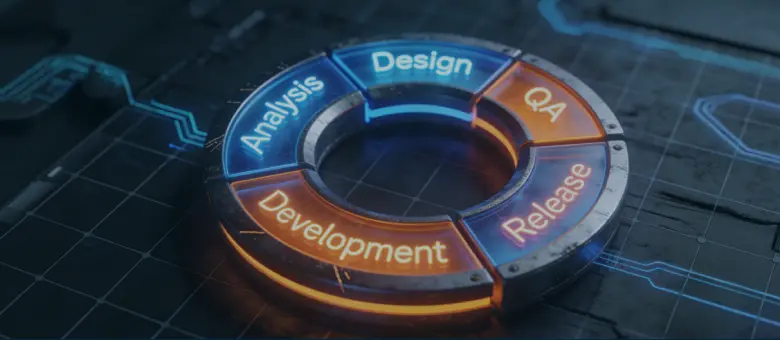
Imagine a mid-size fintech that spends four months fine-tuning a model for customer support, then learns that a retrieval-augmented generation (RAG) pipeline would have shipped in a few weeks. Other teams make the opposite mistake. They bolt RAG onto a task that needs deep behavioral change, and accuracy stalls no matter how good the retrieval is. Both mistakes trace back to choosing an approach before testing it, the first step our LLM development services team takes on every project.
TL;DR:
Building a large language model (LLM) from scratch rarely pays off outside hyperscalers, because frontier-scale training runs cost tens of millions of dollars. Fine-tuning fits stable, well-defined tasks where tone and behavior matter more than fresh facts. RAG fits knowledge that changes often and must stay auditable. High-stakes production systems usually combine the two, and a test on 100 to 500 real queries should settle the choice before you commit budget.
Cut software engineering and design costs by over 50% by engaging thoroughly vetted experts across 15+ global hubs.
Talk to our expertsWhy custom LLM decisions carry higher stakes in 2026
Adoption is broad, and the pressure to ship is rising. Stanford HAI’s 2026 AI Index reports that 88% of organizations used AI in 2025, and The Business Research Company projects the custom LLM training platforms market will grow from $2.82 billion in 2025 to $8.63 billion by 2030. Deloitte’s State of AI in the Enterprise 2026 found that only 25% of respondents have moved 40% or more of their AI experiments into production, while 54% expect to reach that level within three to six months. As more teams rush experiments into production, a wrong architecture choice costs more to fix.
What is custom LLM development?
Custom LLM development adapts a large language model to your data, workflows, and risk requirements through fine-tuning, retrieval, or training a new model, rather than using a general-purpose API as-is. A support team that connects an LLM to its help-center articles through RAG already does this, even though the model’s weights never change. The three approaches below show how that adaptation happens. If you are weighing custom AI more broadly, not only LLMs, see our guide to building a custom AI solution for your business.
How do fine-tuning, RAG, and training from scratch each customize an LLM?
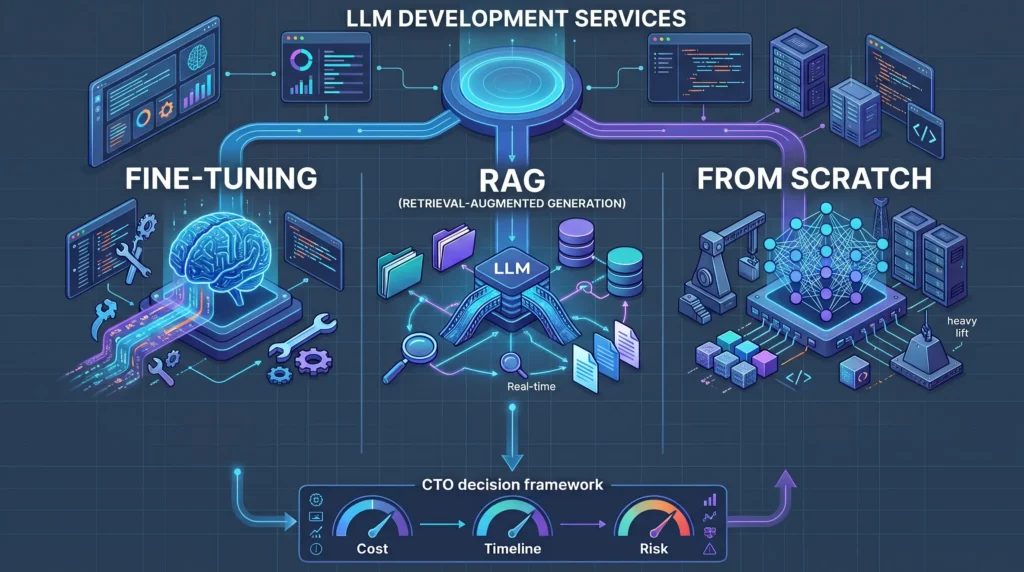
Each approach changes a different part of the system: fine-tuning changes the model’s weights, RAG changes what the model sees at query time, and training from scratch changes everything.
Fine-tuning: teaching an existing model your domain
Fine-tuning continues training a pre-trained model on a smaller, labeled dataset from your domain, such as medical records, legal contracts or support transcripts. The model absorbs that domain’s vocabulary, tone and reasoning patterns. Techniques such as low-rank adaptation (LoRA) update only a small share of the model’s parameters, which cuts training cost compared with retraining the full model.
Fine-tuning fits when:
- Outputs must follow a brand voice, legal phrasing, or a structured format such as JSON, contracts, or reports.
- Domain vocabulary is specialized enough that a general model regularly gets it wrong.
- A smaller fine-tuned model must match a larger general model on one narrow task.
The trade-offs are data, overfitting, and freshness. Fine-tuning typically needs hundreds to thousands of high-quality labeled examples, and narrow datasets raise the risk of overfitting, where the model memorizes examples instead of learning the pattern. Knowledge also freezes at training time, so any new policy, product, or regulation means retraining.
RAG: grounding answers in your own data
RAG leaves the model’s weights untouched. At query time, it retrieves relevant information from an external knowledge base, such as documents, a product catalog, or a ticketing system, and passes it to the model alongside the question.
A RAG system has four parts. A retriever searches the knowledge base, a vector store holds the indexed content, and an embedding model turns text into searchable vectors. The LLM then writes the answer based on what it retrieves.
RAG fits when:
- The underlying information changes weekly or faster, such as policies, prices, inventory, or news.
- Answers need a visible audit trail back to a source document.
- The team has strong data engineering skills but limited ML training infrastructure.
RAG is only as good as the data it retrieves. Poorly chunked documents, meaning text split into badly sized passages, or weak retrieval logic produce confident wrong answers, however capable the model is. Building a reliable retrieval pipeline is an engineering project of its own, and our guide to AI chatbot development covers the implementation details for customer-facing support bots, one of the most common production uses.
Training from scratch: when nothing else fits
Training a foundation model from scratch means designing the architecture, assembling a training corpus, and running the full pretraining cycle. This is how models such as GPT and Llama were built. Frontier-scale training is expensive: Stanford’s AI Index estimated compute costs of about $78 million for GPT-4 and $191 million for Gemini Ultra.
For almost every business application, reproducing that is the wrong call, because pre-trained models already encode broad language understanding. Training from scratch only makes sense when:
- The domain has language patterns that no existing model captures, such as a narrow scientific or proprietary notation.
- The organization has hyperscaler-level compute budgets and a deep ML research team.
- Data sensitivity rules out starting from any existing pre-trained model, including open-weight ones.
- Full control over architecture and training data is a hard requirement, not a preference.
For most companies, the real decision is between fine-tuning, RAG, or a combination of both.
Key takeaway: fine-tuning changes how a model behaves, RAG changes what it knows at query time, and training from scratch is justified only when no existing model can be adapted.
How do fine-tuning, RAG and training from scratch compare on cost, time and risk?
RAG is the cheapest and fastest to start, fine-tuning costs more upfront but gives tighter control over behavior, and training from scratch costs the most by a wide margin.
| Factor | Fine-tuning | RAG | Training from scratch |
| Upfront cost | Medium to high (GPU training, data labeling) | Low to medium (retrieval infrastructure, no model training) | Very high (frontier-scale runs cost tens of millions of dollars) |
| Typical time to production | 4–12 weeks | 2–6 weeks | 12+ months |
| Data requirements | Hundreds to thousands of labeled, task-specific examples | An indexed knowledge base, no labeling | Massive, broad training corpus |
| Team needed | ML engineers, training infrastructure | Data and backend engineers, retrieval expertise | Full ML research team |
| Ongoing maintenance | Retraining cycle for each major update | Refresh the knowledge base, no retraining | Continuous pretraining investment |
| Knowledge freshness | Frozen until the next retraining | Current as of the last data refresh | Frozen until the next full training run |
| Hallucination risk | Can still invent facts outside the training data | Lower when retrieval is accurate, higher when retrieval fails | Depends on training data quality |
| Auditability | Harder: knowledge sits in model weights | Easier: answers trace back to source documents | Hardest, unless built for traceability |
| Best fit | Stable domain tasks, tone and format consistency | Fast-changing knowledge, compliance-sensitive answers | Rare, highly specialized or sovereign-data cases |
Time and effort ranges are indicative planning figures, not published benchmarks. Validate them against your data volume, model size, and compliance needs.
When does combining fine-tuning and RAG beat either one alone?
A hybrid system beats either approach alone when a use case needs both a specialized reasoning style and fast-changing facts. It fine-tunes a model for domain reasoning, tone, and structured output, then adds RAG to pull in facts that no retraining cycle could keep current.
Consider an advisory platform in financial services as an illustrative case. Fine-tuning teaches the model to reason about portfolio risk in the firm’s own style. RAG supplies today’s market data, filings, and account details at query time. Neither approach alone meets both needs: fine-tuning cannot stay current, and RAG cannot teach a new reasoning style.
The cost is complexity. A hybrid system needs ML expertise for fine-tuning and strong data engineering for retrieval. In high-stakes domains such as healthcare decision support, legal research, and regulated financial advice, that added complexity is usually worth it. If you are adding this to an existing product rather than building a new one, our guide to accelerating app development with LLMs covers that path.
How should you evaluate each approach before committing budget?
Test each approach on 100 to 500 real queries from your own domain before you commit budget, a practical range that exposes the obvious failure modes. Teams that skip this step learn their approach was wrong in production, the most expensive place to learn. Measure:
- Task accuracy on domain-specific questions
- Latency at the 95th percentile, not only the average
- Cost per query at expected production volume, not pilot volume
- Failure rate: timeouts, empty answers, or responses that ignore the retrieved context
- Grounded answer rate for RAG: how often the answer is supported by the retrieved documents, not only plausible
Run this as an ongoing loop, not a one-time gate. A November 2025 arXiv preprint tested ten publicly available safety guardrail models and found that the top performer, Qwen3Guard-8B, scored 91% on public benchmark prompts but 33.8% on novel prompts written for the study. The study covers guardrail models, not RAG or fine-tuned systems, but the lesson carries over: public benchmark scores overstate real-world performance, so test on queries your system has not seen.
Increase the ROI of software projects by over 3x with AI-augmented remote development and design solutions tailored to your business goals.
Book a consultationHow can you reduce hallucination risk in production?
Neither fine-tuning nor RAG eliminates hallucination on its own, but four safeguards reduce it:
- Surface the sources: in RAG systems, show the retrieved snippets behind each answer so users and auditors can verify it.
- Add confidence signals: flag low-confidence answers instead of presenting every response with the same certainty.
- Validate before showing: check that the generated answer is supported by the retrieved context before it reaches the user.
- Keep a human in the loop for high-stakes decisions.
Human review is already the norm in production. An arXiv study, Measuring Agents in Production, found that 74% of 86 deployed AI agent systems rely primarily on human-in-the-loop evaluation. These safeguards matter most in healthcare, legal, and financial use cases, where a single confidently wrong answer carries liability. They are cheap enough to apply everywhere.
How do you choose the right approach for your project?
Choose by how fast your knowledge changes, what expertise your team has, whether style or facts matter more, and where the system will run.
Four questions to ask before you decide
- How often does the underlying knowledge change? Daily or weekly points to RAG. Monthly or rarely makes fine-tuning viable. Stable reasoning plus fast-changing facts points to a hybrid.
- What expertise does the team have? Strong data engineers with limited ML infrastructure point to RAG. ML engineers with training infrastructure point to fine-tuning. Both point to a hybrid.
- What matters more, style or facts? Consistent tone and formatting point to fine-tuning. Accurate, current information points to RAG. Both point to a hybrid.
- Where will the system run? Cloud-connected deployments suit RAG with a hosted model. Offline or edge deployments can use fine-tuning or RAG with a local model and vector store.
Starting points by industry
Treat these as starting points to test, not fixed answers.
- Customer support (SaaS): RAG first. Connect the model to product documentation and FAQs so answers stay current without retraining.
- Legal drafting: fine-tuning or hybrid. Contract generation benefits from consistent structure and tone, and citing precedent or clauses usually calls for retrieval as well.
- Healthcare decision support: hybrid. Fine-tune on clinical reasoning patterns, then use RAG for current guidelines and patient-specific data.
- Financial advisory: hybrid. Fine-tune for the firm’s analytical style, and use RAG for live market data and account details.
Key takeaway: if your answers must stay current, start with RAG. Add fine-tuning only when evaluation shows that tone, format, or domain reasoning still fall short.
How much does custom LLM development cost?
RAG costs the least to start, fine-tuning costs more upfront, and training from scratch costs the most by a wide margin, with frontier-scale runs estimated in the tens of millions of dollars.
- RAG: most of the cost sits in the retrieval pipeline (data pipelines, vector database, embeddings), not in model training. Early deployment is typically measured in weeks.
- Fine-tuning: a higher upfront cost for training compute and for the labor to curate labeled examples. Per-query cost can fall once training is done, especially with a smaller model.
- Training from scratch: costs scale to tens of millions of dollars at frontier scale, so it is rarely economical outside hyperscalers.
Exact figures vary with model size, data volume, and vendor rates, so compare total cost over the system’s expected lifetime, not setup cost alone. Data quality is the cost driver teams most often underestimate: a RAG system is only as good as the documents it retrieves, and a fine-tuned model is only as good as its labeled examples. Budget time for data cleanup before the project timeline starts, not during it.
How do fine-tuning and RAG differ on security and compliance?
RAG is easier to audit and control because it keeps sensitive data in an access-managed database instead of baking it into model weights. That makes it simpler to restrict access by role and to delete data on request, which matters under data-residency and right-to-erasure rules. Fine-tuning embeds training data in the model itself, which is harder to audit and nearly impossible to selectively “forget” without retraining.
Governance is lagging deployment. Deloitte surveyed 3,235 leaders for its State of AI in the Enterprise 2026 report and found that only 21% have a mature governance model for autonomous AI agents. For regulated use cases, that gap shows up after launch, not before it.
Practical minimums for any regulated deployment: encrypt data at rest, enforce role-based access to the retrieval layer or training data, and log every interaction for review.
How does AgileEngine approach custom LLM projects?
AgileEngine’s AI Studio team starts every engagement with the question this guide walks through: does the use case need fine-tuning, RAG, or both? The team makes that call before writing code, so the architecture follows evidence instead of habit. AI Studio builds RAG-based knowledge assistants, LLM-powered copilots, and hybrid architectures across regulated industries, where the governance and auditability trade-offs above are not optional.
One example is a healthcare startup with $60M+ in funding that worked with AgileEngine on a HIPAA-compliant AI copilot. HIPAA is the US healthcare data privacy law. The copilot automates clinical workflows, including patient access, prior authorization, chart review, and provider-facing analytics, and it runs on RAG and LLMs, with OpenAI GPT models alongside open-source models. Over two years, AgileEngine handled roughly 30% of the client’s merged pull requests, about 1,200 PRs, across AI engineering, data engineering, and full-stack development.
Next step: map your use case before you commit budget
Before you commit budget, write down three facts about your use case: how often the underlying knowledge changes, which skills your team already has, and whether tone or factual accuracy matters more. Then run 100 to 500 real queries against a RAG prototype and, if tone or format still falls short, against a fine-tuned candidate. These two steps usually settle the architecture question faster than design discussions do.
Grow faster with dedicated teams of top 1% software experts, speeding up time-to-hire by 3x and project delivery by 2x.
Let’s talkFAQs
Yes, on a narrow, well-defined task. A smaller fine-tuned model can match a larger general model on that task while costing less per query. It will not carry that performance over to unrelated tasks, so test it on your own queries first.
Refresh it at least as often as the underlying content changes. For policies, prices, or inventory, that means a scheduled or event-driven sync, not a manual upload. Show a last-updated date next to each source so users can judge freshness.
A hybrid system needs ML engineers for fine-tuning, data engineers for the retrieval pipeline, and an owner for evaluation. Small teams often start with RAG and add fine-tuning once evaluation shows a clear gap.
Yes, and many teams do. A running RAG system generates real queries, answers, and user feedback that you can curate into a labeled dataset for fine-tuning. That makes RAG a low-risk starting point.
Not always. RAG keeps your documents in your own database, but retrieved passages still reach the model at query time, so a hosted model sees them. Open-weight models can run in your own cloud or on-premises environment to avoid that, and if you use a hosted API, review the provider’s data-retention and training terms first.






![A smartphone and a tablet with monetization elements (banner ad and in-app purchase button) displayed on the screen]](https://agileengine.com/wp-content/uploads/2026/03/How-Do-Free-Apps-Make-Money_-Monetization-Explained.webp)