
Almost every software vendor now offers artificial intelligence (AI) agent development, and most of their service pages make the same promises. The differences surface after you sign: in whether the agent works with your systems, holds up in production, and keeps running when models change. This guide groups AI agent development companies into five segments, from product engineering firms to ready-made agent platforms, so you can shortlist by fit instead of by claims.
Disclosure: AgileEngine publishes this list and ranks itself among the companies. We applied the same selection criteria to every company, including our own.
TL;DR
- Product engineering and dedicated teams: AgileEngine, HatchWorks AI, Azumo, and Rootstrap. Choose this segment when agents need to work inside an existing product or workflow or when launching new agentic initiatives.
- Specialized AI agent studios: Vstorm, SoftKraft, LeewayHertz, and Neurons Lab. Choose these for complex multi-agent orchestration or industry-specific agents.
- Staff augmentation and AI talent: BairesDev and Turing. Choose these when your team owns delivery and needs AI engineers quickly.
- Enterprise consultancies: Accenture and IBM Consulting. Choose these for multi-year programs that span several business functions.
- AI agent platforms: Salesforce Agentforce, Microsoft Copilot Studio, and Sierra. Choose a platform when a ready-made agent already covers your use case.
If you read nothing else: ask every vendor to walk you through a production agent it has built, and confirm in the contract that you’ll own the prompts and evaluation sets.
Why 2027 raises the stakes for AI agent projects
Agent adoption among large companies is now mainstream, but running agents profitably and safely is not. KPMG’s Q3 2026 AI Pulse Survey found that 62% of large US organizations are building, deploying, or developing AI agents, up from 53% one quarter earlier. Costs are catching up: in KPMG’s Q2 2026 global survey, 49% of executives said operating costs outweigh returns, and nearly half have delayed or scaled back agent deployments.
Governance lags too. Deloitte’s State of AI in the Enterprise 2026 found that only 21% of organizations have a mature governance model for agentic AI. Gartner expects over 40% of agentic AI projects to be canceled by the end of 2027.
Vendor claims add to the risk. Gartner estimates that only about 130 of the thousands of vendors claiming agentic capabilities actually offer them. It calls the practice of rebranding chatbots and automation tools as agents “agent washing.”
Five shifts impact vendor selection in 2027:
- Interoperability standards are now in place. The Model Context Protocol (MCP) connects agents to tools and data. The Agent2Agent (A2A) protocol lets agents from different vendors work together. Agents built on them are easier to connect to new tools and to hand over between vendors, so ask which of the two a vendor has shipped in production.
- Platforms and models change fast. OpenAI deprecated its visual Agent Builder in June 2026, eight months after launch. Agents built without a migration path can end up stranded on a retired platform.
- Pricing is moving to outcomes. Major software vendors now charge per resolution or per action for their agents. Budget for running costs as well as the initial build.
- Regulatory timelines are firmer. The EU’s Digital Omnibus agreement moves high-risk obligations to 2 December 2027 for standalone systems and 2 August 2028 for product-embedded systems. In the US, Colorado replaced its original AI Act with a narrower automated decision-making technology (ADMT) disclosure framework, effective January 1, 2027.
- AI labs now sell services. OpenAI and Anthropic launched their own deployment companies in May 2026. Both build only on their own models, which matters if you need to stay model-neutral.
Key takeaway: Most agent programs now stall on running costs and governance, not on the initial build. Ask every shortlisted vendor how it monitors cost per task and controls agent actions in production.
What does an AI agent development company do?
An AI agent development company designs, builds, and maintains AI agents for other businesses. An agent is software in which a large language model (LLM) plans a task, calls your tools and data to complete it, and adapts to the results. Unlike a chatbot, it acts inside your systems, so most of the work goes into making those actions reliable and safe.
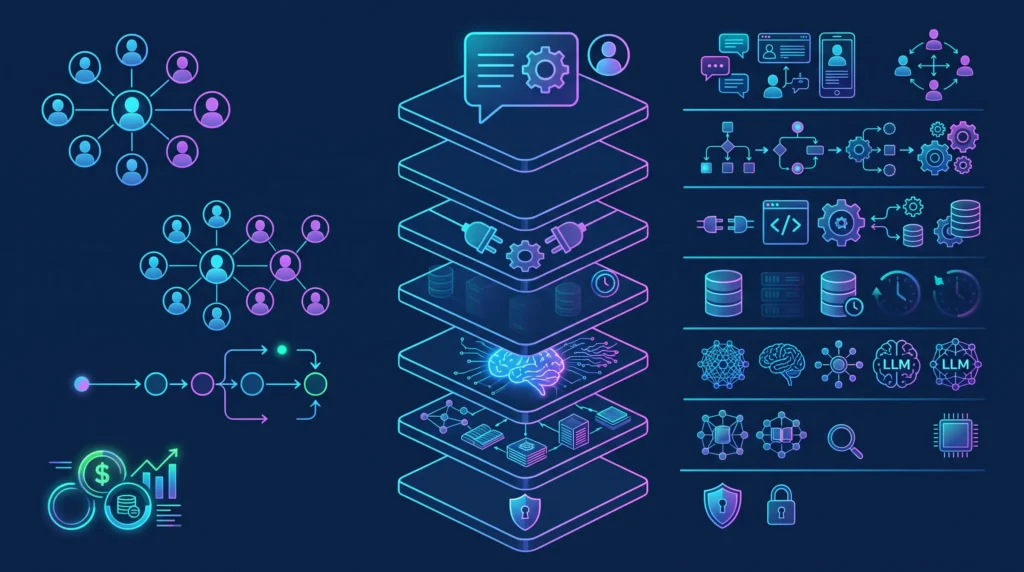
Most engagements cover six areas:
- Use-case scoping: picking a workflow with a measurable outcome, such as invoice exceptions or support triage, and agreeing on success metrics.
- Architecture: choosing models, frameworks such as LangGraph or CrewAI, and a single-agent or multi-agent design.
- Integration: connecting agents to customer relationship management (CRM) and enterprise resource planning (ERP) systems, databases, and application programming interfaces (APIs), increasingly through MCP.
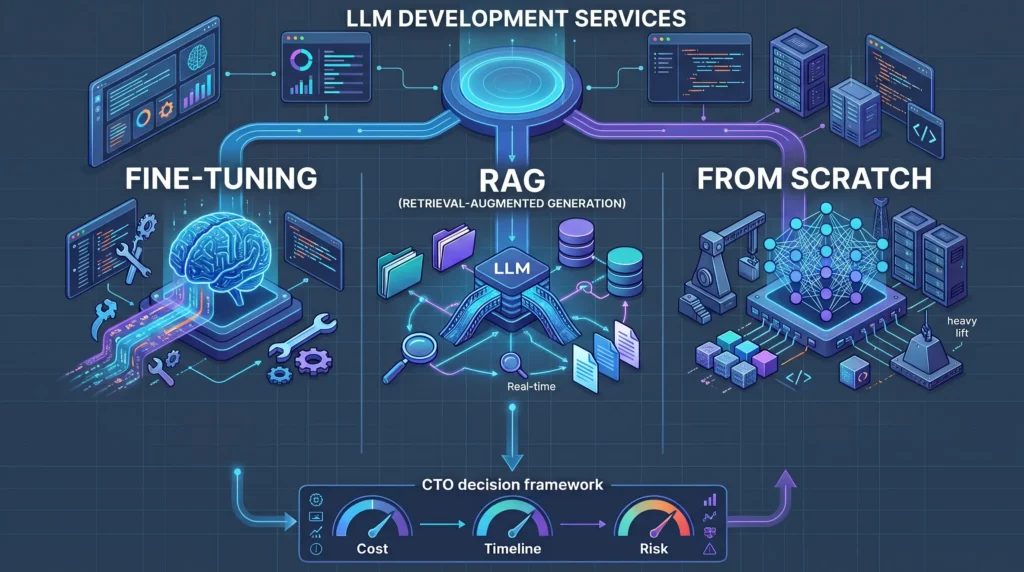
- Knowledge retrieval: building retrieval-augmented generation (RAG), which lets an agent answer from your own documents and data. Our comparison of fine-tuning, RAG, and building from scratch explains when each approach fits.
- Guardrails and evaluation: permissions, human approval for high-impact actions, audit logs, and test sets that check output quality before each release.
- Operations: monitoring cost per task, failures, and output quality after launch, and migrating the agent when a model is retired.
For architecture, team roles, and budgets in more detail, see our guide to building an AI agent for your business.
AI agents vs chatbots vs RPA vs copilots
These four technologies differ in who decides the next step and whether the software can act on its own. Robotic process automation (RPA) and chatbots follow scripts, copilots assist a person, and agents choose and execute steps within the limits you set.
| AI agent | Chatbot | RPA bot | Copilot | |
|---|---|---|---|---|
| Who decides the next step | The model, within set permissions | A script or the user | A fixed script | The person using it |
| Acts in other systems | Yes, through tools and APIs | Rarely | Yes, through scripted steps | Usually suggests; a person acts |
| Handles exceptions | Adapts or escalates to a person | Hands off to a person | Stops outside its rules | The person handles them |
| Typical uses | Order exceptions, claims triage, reconciliation | FAQs, simple support requests | Data entry, form processing | Drafting, coding, research |
Key takeaway: If a vendor’s “agent” never chooses its own next step or acts in a system without a script, it’s a chatbot or an RPA bot. Ask to see what decisions the agent makes and which actions it can take.
Should you hire an AI agent development company, augment your team, or buy a platform?
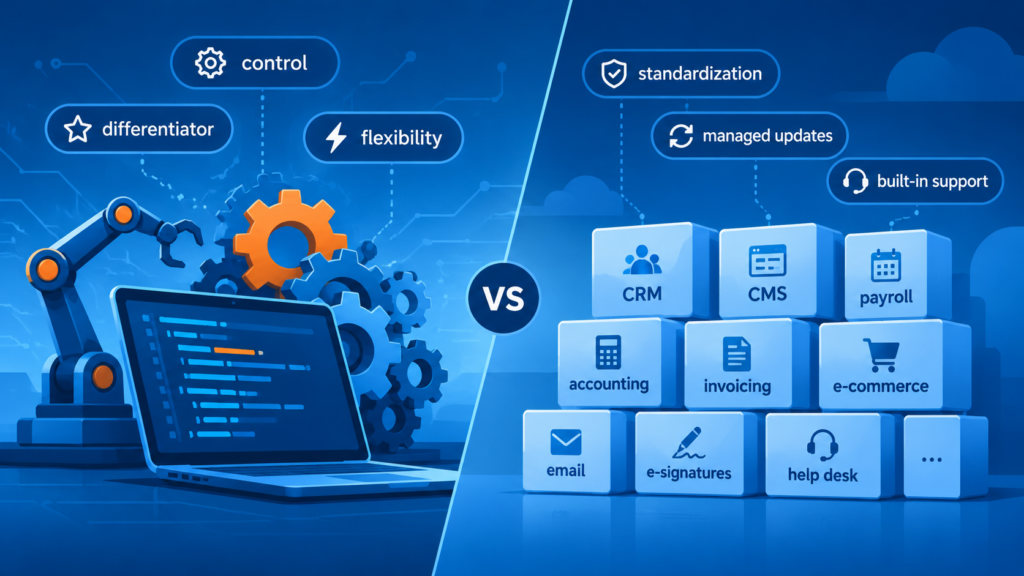
The right route depends on how common your use case is and who will own delivery. Buy a platform when a ready-made agent covers a common job. Augment your team when you already run delivery and need more AI engineers. Hire a development company for product-level or feature-level initiatives that require autonomy and ownership over delivery outcomes.
Most enterprises already buy before they build. Menlo Ventures found that 76% of enterprise AI use cases in 2025 were purchased rather than built internally, up from 47% a year earlier. Buying covers the first version, though. Someone still has to maintain the agent when models, processes, and data change.
The five routes below match the five segments in this guide:
| Route | When it fits | What you own | Main risk | Segment in this guide |
|---|---|---|---|---|
| Buy an agent platform | A common job, such as customer service or an IT helpdesk, inside an ecosystem you already use | Configuration and your data, not the agent’s logic | Lock-in and per-action pricing that grows with volume | AI agent platforms |
| Augment your team | You have product and engineering leadership and need AI engineers quickly | Everything; you manage delivery | Delivery and quality risk stay with you | Staff augmentation and AI talent |
| Hire a product engineering partner | Agents inside an existing product or workflow, or a new agentic product | Code, prompts, and evaluation sets, if the contract says so | Choosing on demos instead of production evidence | Product engineering and dedicated teams |
| Hire a specialized agent studio | Complex multi-agent orchestration or a domain-specific agent | Code, prompts, and evaluation sets, if the contract says so | Less capacity for the product work around the agent | Specialized AI agent studios |
| Engage an enterprise consultancy | Multi-year programs across several business functions, with change management | Program outputs, often built on partner platforms | Cost and pace for a single use case | Enterprise consultancies |
The routes also combine well. A dedicated team can build custom agents for core workflows while a platform agent handles routine support tickets.
AI labs’ deployment companies are a sixth option. They suit organizations already committed to OpenAI or Anthropic models. We left them off the list because they build only on their own models.
Key takeaway: Decide what you need to own a year from now before you compare vendors. If the answer includes prompts, evaluation sets, and integration code, rule out platforms and write that ownership into the contract.
How we selected the best AI agent development companies
We shortlisted companies that build and run AI agents for other businesses, then checked each one against five criteria:
- Dedicated agent services: the company offers AI agent or agentic AI development as a named service.
- Production evidence: published case studies, client references, or documented agentic solutions show work beyond prototypes.
- Integration depth: the company has connected agents to business systems such as CRM and ERP platforms, data warehouses, or internal APIs.
- Governance: the company describes how it handles guardrails, human review, evaluation, and monitoring after launch.
- Third-party validation: verified client reviews, analyst recognition, or named enterprise clients.
We excluded vendors that rebrand chatbots or RPA tools as agents, strategy-only consultancies that don’t build production systems, and AI labs’ deployment companies, which build only on their own models.
We evaluated the three agent platforms separately, on ecosystem fit, pricing model, and the use cases they cover without custom development.
Ratings, hourly rates, and minimum project sizes come from Clutch. Founding year, headquarters, headcount, delivery locations, and case studies come from company websites and LinkedIn. We checked all information in November 2026 and will review the list every 6–12 months.
Top AI agent development companies at a glance
The table below compares the 12 AI agent development companies on this list by segment, location, services, size, and best fit. Some companies on this list span two or more segments. For example, AgileEngine runs dedicated product teams, while its AI Studio coordinates most of its AI projects. Many companies that specialize in remote development offer both dedicated team and staff augmentation services, though one usually takes the lead. Each profile below appears under the company’s primary segment, and the table notes the most relevant secondary segment where one applies.
| Company | Segment | Headquarters and delivery regions | Core services | Team size | Best for |
|---|---|---|---|---|---|
| AgileEngine | Product engineering and dedicated teams (secondary: specialized AI agent studios) | Boca Raton, Florida; the Americas, Europe, and Asia | AI agents, data engineering, full-stack development, QA, UX design | 900+ | Agents embedded in existing products and workflows, with data, engineering, and QA in one team |
| HatchWorks AI | Product engineering and dedicated teams (secondary: staff augmentation and AI talent) | Atlanta, Georgia; Latin America | AI-first custom development, multi-agent systems, RAG | 250–999 | US companies that want a nearshore team accountable for a defined outcome |
| Azumo | Product engineering and dedicated teams (secondary: staff augmentation and AI talent) | San Francisco, California; Latin America | AI agents, RAG, LLM fine-tuning, MLOps, data engineering | 50–249 | Department-level agents built by a nearshore team |
| Rootstrap | Product engineering and dedicated teams (secondary: staff augmentation and AI talent) | Beverly Hills, California; Uruguay and Argentina | AI product engineering, agentic workflows, product design | 250–999 | Startups and innovation labs building AI-native products |
| Vstorm | Specialized AI agent studios | Poland | Multi-agent systems, agent orchestration, integration | 40+ | Custom multi-agent orchestration for mid-market companies |
| SoftKraft | Specialized AI agent studios | Poland | LangGraph agents, RAG, data engineering | 50+ | Python-based agents grounded in private knowledge bases |
| LeewayHertz | Specialized AI agent studios (secondary: AI agent platforms) | Gurugram, India | Multi-agent systems, ZBrain platform, enterprise integration | 50–249 | Platform-led multi-agent development |
| Neurons Lab | Specialized AI agent studios | London, UK; Singapore | Financial services agents, governance, AWS deployment | 50–249 | Banks, insurers, and wealth managers |
| BairesDev | Staff augmentation and AI talent (secondary: product engineering and dedicated teams) | San Francisco, California; the Americas | Staff augmentation, dedicated teams, AI engineering | 4,000+ | Scaling AI engineering capacity with US time-zone overlap |
| Turing | Staff augmentation and AI talent | San Francisco, California | AI engineering talent, agent development support | 1,001–5,000 | Teams that need vetted AI engineers quickly |
| Accenture | Enterprise consultancies | Dublin, Ireland; global | Agent programs, pre-built agents, platform integration | ~799,000 | Multi-year programs across several business functions |
| IBM Consulting | Enterprise consultancies | Armonk, New York; global | Agent strategy, watsonx Orchestrate, multi-cloud governance | 150,000+ | Regulated enterprises managing agents across clouds and models |
AI agent platforms at a glance
The three platforms below sell ready-made agents rather than development services, so we compare them on different criteria.
| Platform | Vendor headquarters | Ecosystem | Pricing model | Best for |
|---|---|---|---|---|
| Salesforce Agentforce | San Francisco, California | Salesforce Sales, Service, and Marketing Cloud | Per action (Flex Credits) or per conversation | Customer service and sales teams already on Salesforce |
| Microsoft Copilot Studio | Redmond, Washington | Microsoft 365, Teams, Dynamics 365, Power Platform | Copilot Credits, pay-as-you-go or capacity packs | Internal agents for companies on Microsoft 365 |
| Sierra | San Francisco, California | Standalone; integrates with existing CRM and support tools | Outcome-based | Customer-facing agents for consumer brands |
The 12 best AI agent development companies in 2027
We grouped the companies below by segment. Each profile follows the same template: an overview, the key facts, a verifiable agentic AI track record, and the scenarios the company fits best.

Product engineering and dedicated teams. These companies build agents as part of broader product work, so the same team handles the agent, the data behind it, and the software around it.
1. AgileEngine
AgileEngine is a software development and AI services company founded in 2013 and headquartered in Boca Raton, Florida. It builds AI agents through its AI Studio and delivers them with dedicated teams covering data engineering, full-stack development, quality assurance (QA), and user experience (UX) design. AI Studio also advises clients on agent-driven development and the automation of enterprise workflows. Most of its clients are US companies.
- Headquarters and delivery locations: Boca Raton, Florida; 15+ delivery hubs in the Americas, Europe, and Asia
- Team size: 900+
- Core services: AI agent development, data engineering, full-stack development, QA, UX design
- Agent capabilities: RAG pipelines, large multimodal models (LMMs), MCP, agentic workflows, multi-LLM evaluation, prompt engineering
- Clutch: 5.0/5 from 66 reviews; hourly rate $25–$49; minimum project size $25,000+
- Best for: Agents embedded in existing products and workflows, with data, engineering, and QA in one team, plus guidance on adopting and optimizing agentic AI
Agentic AI track record: AgileEngine built core backend and AI functionality for an agentic AI platform that modernizes enterprise apps 10x faster, including LLM pipelines that transform legacy ServiceNow code and generate documentation. The platform’s customers save 60% on development costs. AgileEngine has also built AI solutions for clinical workflows in healthcare, voice-over production in media, and enterprise decision intelligence. Clutch lists it among its top machine learning companies.
2. HatchWorks AI
HatchWorks AI is an AI-first software development company based in Atlanta, Georgia, with nearshore teams in Latin America. It delivers work through Agentic AI Pods: small product, engineering, and quality teams accountable for a defined outcome instead of a task list. Its Generative-Driven Development (GenDD) method embeds AI across the delivery lifecycle, from requirements to testing.
- Headquarters and delivery locations: Atlanta, Georgia; Latin America
- Team size: 250–999
- Core services: AI-first custom development, multi-agent systems, RAG, AI strategy
- Agent capabilities: Multi-agent systems combined with RAG, connected to company knowledge, systems, and tools
- Clutch: 4.9/5 from 29 reviews; hourly rate $50–$99; minimum project size $25,000+
- Best for: US companies that want a nearshore team accountable for a defined outcome
Agentic AI track record: HatchWorks AI built AVA, a virtual assistant for Aero Star Aviation, an Embraer maintenance specialist. AVA uses RAG and text-to-SQL to pull aircraft maintenance history from the company’s maintenance software, so technicians can diagnose and resolve work orders faster. In one pilot, recurring actuator issues dropped by about 30% after technicians acted on AVA’s insights.
3. Azumo
Azumo is an AI and software development company founded in 2016 and headquartered in San Francisco, with nearshore engineering teams mainly in Argentina. It covers the full AI delivery cycle, from data preparation and model selection to deployment, monitoring, and optimization.
- Headquarters and delivery locations: San Francisco, California; Latin America
- Team size: 50–249
- Core services: AI agent development, RAG, LLM fine-tuning, machine learning operations (MLOps), data engineering
- Agent capabilities: Agents for customer support, finance, human resources (HR), sales, and operations, integrated with platforms such as Salesforce, SAP, Oracle, and ServiceNow
- Clutch: 4.9/5 from 27 reviews; hourly rate $25–$49; minimum project size $10,000+
- Best for: Department-level agents built by a nearshore team
Agentic AI track record: Azumo built and runs a production AI receptionist on its own phone line. The voice agent answers live calls with a median response time of 1.7 seconds.
4. Rootstrap
Rootstrap is a product engineering company founded in 2011, with headquarters in Beverly Hills, California, and delivery hubs in Uruguay and Argentina. It builds AI-native products for startups and enterprise innovation teams, combining product strategy, design, and engineering.
- Headquarters and delivery locations: Beverly Hills, California; Uruguay and Argentina
- Team size: 250–999
- Core services: AI product engineering, agentic workflows, RAG, product design, staff augmentation
- Agent capabilities: Multi-agent systems, RAG over proprietary data, and integrations with models from OpenAI, Anthropic, and Meta
- Clutch: 4.8/5 from 44 reviews; hourly rate $50–$99; minimum project size $50,000+
- Best for: Startups and innovation labs building AI-native products
Agentic AI track record: Rootstrap develops multi-agent systems for document analysis, pattern detection, and decision support, with audit trails and explainability built in. It runs delivery on Rootshift, its own AI-native delivery system, and holds System and Organization Controls 2 (SOC 2) certification.

Specialized AI agent studios. These firms focus on agents and the AI systems behind them, often with deep expertise in one framework, platform, or industry.
5. Vstorm
Vstorm is an applied agentic AI engineering consultancy founded in 2017 and based in Wrocław, Poland. It builds custom agentic workflows for mid-market companies and contributes to open-source agent frameworks.
- Headquarters and delivery locations: Wrocław, Poland
- Team size: 40+
- Core services: Multi-agent system development, agent orchestration, integration with existing business systems
- Agent capabilities: Pydantic AI, LangChain, and open-source agent tooling; Silver Member of the Agentic AI Foundation (AAIF)
- Clutch: 4.9/5 from 21 reviews; hourly rate $100–$149; minimum project size $10,000+
- Best for: Mid-market companies that need custom multi-agent orchestration
Agentic AI track record: Vstorm received the AAIF’s first Open Agentic AI Innovation Award. Its open-source project template generates AGENTS.md files by default, so AI coding agents get correct build commands and architectural boundaries in every project it scaffolds.
6. SoftKraft
SoftKraft is a Python-focused software and AI development company founded in 2015 and based in Bielsko-Biała, Poland. It builds model-agnostic agents with a test-driven development (TDD) approach.
- Headquarters and delivery locations: Bielsko-Biała, Poland
- Team size: 50+
- Core services: AI agent design, RAG architecture, data engineering
- Agent capabilities: LangGraph agents that plan and execute multi-step tasks; RAG on vector databases such as Pinecone and Weaviate
- Clutch: 5.0/5 from 25 reviews; hourly rate $50–$99; minimum project size $10,000+
- Best for: Python-based agents grounded in private knowledge bases
Agentic AI track record: SoftKraft built an AI assistant that analyzes connections between complex legal contracts. It also developed a SaaS product that uses AI to assess the Scope 3 emissions impact of procurement decisions.
7. LeewayHertz
LeewayHertz is an AI consulting and development company founded in 2007 and now part of The Hackett Group. It builds single-agent and multi-agent systems connected to enterprise data, applications, and workflows.
- Headquarters and delivery locations: Gurugram, India; United States
- Team size: 50–249
- Core services: Multi-agent systems, AI consulting, enterprise integration, its ZBrain platform
- Agent capabilities: Agent crews orchestrated on LangGraph, Google’s Agent Development Kit (ADK), or Microsoft Semantic Kernel through ZBrain; custom agents built with CrewAI
- Clutch: 4.7/5 from 9 reviews; hourly rate $50–$99; minimum project size $10,000+
- Best for: Enterprises that want a platform-led approach to multi-agent development
Agentic AI track record: LeewayHertz runs ZBrain, its own end-to-end AI enablement platform with two modules, ZBrain AI XPLR and ZBrain Builder. Gartner named LeewayHertz a representative vendor in its 2024 Hype Cycle for Generative AI.
8. Neurons Lab
Neurons Lab is a boutique AI consultancy for financial services, based in London and Singapore. It serves mid-market banks, insurers, and asset managers in the US, UK, and Asia.
- Headquarters and delivery locations: London, UK; Singapore
- Team size: 50–249
- Core services: Financial services agents, AI training, governance, deployment on Amazon Web Services (AWS)
- Agent capabilities: An “AI Agent Factory” model that assembles agents from reusable components; engineers embedded with client teams
- Clutch: 5.0/5 from 5 reviews; hourly rate undisclosed; minimum project size $100,000+
- Best for: Banks, insurers, and wealth managers that need governed agents
Agentic AI track record: Neurons Lab built an agent-driven research environment for a Japanese asset management firm. Agents continuously update risk models from macroeconomic and fundamental data, and the portfolio’s Sharpe ratio improved from 0.4 to 0.6. In June 2026, the company earned the AWS AI Competency in the Agentic AI category.

Staff augmentation and AI talent. These companies add vetted AI engineers to your team. You keep ownership of delivery, architecture, and priorities.
9. BairesDev
BairesDev is a nearshore software development company founded in 2009 and headquartered in San Francisco, with engineers across the Americas. It provides staff augmentation, dedicated teams, and end-to-end AI development.
- Headquarters and delivery locations: San Francisco, California; the Americas
- Team size: 4,000+
- Core services: Staff augmentation, dedicated teams, AI and LLM development, prompt engineering
- Agent capabilities: Agentic AI, multi-step prompt flows and agent chains, LLM fine-tuning
- Clutch: 4.9/5 from 63 reviews; hourly rate $50–$99; minimum project size $50,000+
- Best for: Scaling AI engineering capacity with US time-zone overlap
Agentic AI track record: BairesDev has 200+ AI specialists on staff and builds solutions ranging from custom LLMs to agentic AI. Its prompt engineering practice designs multi-step prompt flows and agent chains for complex business processes.
10. Turing
Turing is an AI engineering company headquartered in San Francisco. It supplies vetted AI engineers to enterprises and works with frontier AI labs on model training and evaluation.
- Headquarters and delivery locations: San Francisco, California; global remote talent network
- Team size: 1,001–5,000
- Core services: AI engineering talent, agent development, LLM training and evaluation
- Agent capabilities: Enterprise agents with continuous-learning loops adapted from its reinforcement learning (RL) environments for AI labs
- Clutch: 5.0/5 from 4 reviews; hourly rate $50–$99; minimum project size $50,000+
- Best for: Teams that need vetted AI engineers quickly
Agentic AI track record: Turing built AI pricing agents that cut a grocery retailer’s price rollout from six weeks to 48 hours.

Enterprise consultancies. These firms run agent programs across many business functions, usually alongside platform partners and change management.
11. Accenture
Accenture is a global professional services company headquartered in Dublin, Ireland. It runs agentic AI programs through its AI Refinery platform and partnerships with NVIDIA, ServiceNow, Google Cloud, Anthropic, and OpenAI.
- Headquarters and delivery locations: Dublin, Ireland; global
- Team size: ~799,000
- Core services: Agent strategy and programs, pre-built industry agents, platform integration, workforce training
- Agent capabilities: AI Refinery for custom agents; 300+ pre-built agent skills and workflows through its ServiceNow program
- Clutch: N/A
- Best for: Multi-year programs across several business functions
Agentic AI track record: Accenture has published more than 450 of its own agents on Google Cloud Marketplace. By early 2026, 192,000 of its people had completed an Agentic AI Fundamentals program co-created with Stanford’s Institute for Human-Centered AI.
12. IBM Consulting
IBM Consulting is IBM’s consulting arm, headquartered in Armonk, New York. Its Enterprise Advantage service, launched in January 2026, helps companies build and scale agents across AWS, Google Cloud, Azure, and IBM watsonx.
- Headquarters and delivery locations: Armonk, New York; global
- Team size: 150,000+
- Core services: Agent strategy, watsonx Orchestrate implementation, multi-cloud AI governance
- Agent capabilities: Agent management through watsonx Orchestrate, which supports the A2A and MCP protocols
- Clutch: N/A
- Best for: Regulated enterprises managing agents across clouds and models
Agentic AI track record: IBM used watsonx Orchestrate on its own HR operations as “client zero,” and 94% of company-wide HR requests are now handled through the platform.

AI agent platforms. These vendors sell ready-made agents instead of development services. A platform is often the fastest route when your use case is common and your data already lives in the vendor’s ecosystem.
Platform alternative: Salesforce Agentforce
Agentforce is Salesforce’s platform for building and running agents inside Sales Cloud, Service Cloud, and Marketing Cloud. Agents can create cases, update opportunities, and hand conversations to people with the full customer context attached.
- Ecosystem: Salesforce CRM
- Pricing model: Per action through Flex Credits, or per conversation; requires a Salesforce Enterprise license
- Best for: Customer service and sales teams already running on Salesforce
- When you still need a builder: Agents that act on systems outside Salesforce, or logic the platform’s configuration can’t express
Platform alternative: Microsoft Copilot Studio
Copilot Studio is Microsoft’s low-code tool for building agents across Microsoft 365, Teams, and Dynamics 365. Agents can call Power Automate flows and use Microsoft Graph to work with company email, calendars, and documents.
- Ecosystem: Microsoft 365, Dynamics 365, Power Platform
- Pricing model: Copilot Credits, either pay-as-you-go or in prepaid capacity packs
- Best for: Internal agents, such as HR and IT helpdesks, for companies on Microsoft 365
- When you still need a builder: Customer-facing agents on non-Microsoft channels, or integrations with systems outside the Microsoft stack
Platform alternative: Sierra
Sierra is a platform for customer-facing agents that handle support conversations and take actions in a company’s existing systems. It reached $100 million in annual recurring revenue seven quarters after launch.
- Ecosystem: Standalone; connects to existing CRM, order, and support tools
- Pricing model: Outcome-based, tied to the results the agent delivers
- Best for: Consumer brands that want a branded customer service agent quickly
- When you still need a builder: Internal workflows, or agents that need deep custom logic beyond customer service
Key takeaway: Pick the segment before the vendor. If a platform covers your use case inside a stack you already run, start there. If the agent must act across your own product and systems, shortlist two or three development companies from the same segment and compare their agentic AI track records.
How to choose an AI agent development company in the USA
For US companies, the choice usually comes down to three factors: how many working hours your team shares with the vendor, where your data goes, and what each hour costs. Most companies on this list combine a US presence with delivery teams elsewhere, so the delivery model matters more than the headquarters address.
| Delivery model | Overlap with US working hours | Companies on this list | What to check |
|---|---|---|---|
| US presence with nearshore delivery in Latin America | Full or near-full | AgileEngine, HatchWorks AI, Azumo, Rootstrap, BairesDev | Who leads delivery day to day, and how senior the nearshore engineers are |
| Delivery from Europe or Asia | Partial, usually US mornings | Vstorm, SoftKraft, LeewayHertz, Neurons Lab | Fixed overlap hours, response times for production incidents |
| Global consultancies | Varies by program | Accenture, IBM Consulting | Which parts of the team work onshore, and how pricing changes with the mix |
Time-zone overlap matters more for agents than for most software. Agents need frequent tuning in their first months in production, and a team that answers within the same working day shortens every feedback loop. If you’re weighing nearshore options, our guide to outsourcing software development to Latin America covers rates, talent pools, and engagement models.
Data handling deserves the same scrutiny. Ask where the agent’s data is stored and processed, which cloud regions the models run in, and who on the vendor’s team can access production data. If the agent touches health data, the vendor must sign a business associate agreement (BAA) under the Health Insurance Portability and Accountability Act (HIPAA). For most enterprise buyers, a SOC 2 Type II report is the baseline evidence of security controls.
Cost varies widely within each model. Among the companies on this list that publish Clutch rates, hourly rates range from $25–$49 to $100–$149, and minimum project sizes range from $10,000 to $100,000.
Key takeaway: Decide how many shared working hours your team needs before comparing rates. A cheaper team with a two-hour overlap can cost more once agents go into production and need daily tuning.
How much does AI agent development cost?
AI agent development typically costs $15,000 to $50,000 for a proof of concept and $150,000 or more for a multi-agent enterprise system. Running costs come on top of that and keep growing with usage. The build price depends mostly on the number of systems the agent connects to, how much it acts on its own, and the compliance requirements around it.
| Tier | What it covers | Typical build cost |
|---|---|---|
| Proof of concept | One workflow, limited integrations, test or sample data | $15,000–$50,000 |
| Production agent | One workflow in production, several integrations, evaluation sets, guardrails, and monitoring | $50,000–$150,000 |
| Multi-agent system | Several coordinated agents across business functions, with orchestration, governance, and compliance controls | $150,000–$500,000+ |
The build is only part of the bill. Production agents also carry recurring costs:
- Inference: the tokens the agent consumes on every task, which grow with usage volume and task complexity
- Monitoring and evaluation: tracing, quality checks, and test runs after every prompt or model change
- Human review: the time your team spends approving high-impact actions and handling escalations
- Maintenance: fixing integrations when connected systems change, and migrating to new models when old ones are retired
A common planning assumption is 15–30% of the build cost per year for maintenance, plus inference. Inference is the line most likely to surprise you. Gartner predicts that inference costs per agentic workflow will increase more than fivefold through 2028, even as the price per token keeps falling. Agents reason in loops and call tools repeatedly, so a single task can consume many times the tokens of a chatbot reply.
Engineers keep these costs in check with a few standard techniques. They cap the loops and tool calls an agent can run per task, route routine steps to smaller, cheaper models, cache prompts and repeated queries, and trim the context each call carries. A newer option is a decision model, such as TypeSafe’s Jev or Cloudflare’s Clef. Instead of generating text, these models return probabilities for a fixed set of allowed answers. That makes routing, classification, and other bounded decisions inside an agent faster and cheaper than sending them to a general-purpose LLM.
Optimization tactics aside, a good proposal makes the full cost easy to compare. Ask each vendor to separate one-time build costs from recurring costs, estimate cost per completed task at your expected volume, and explain which of these techniques it plans to use.
Key takeaway: Budget for the first year of operation, not just the build. A vendor that quotes only the build is quoting half the number you’ll actually pay.
What does an AI agent development project look like?
Most AI agent projects move through six phases, from scoping one workflow to running the agent in production. The order resembles any software project, but evaluation and operations take a far larger share of the effort.
- Discovery and data readiness. The team picks one workflow with a measurable outcome, records its current cost and error rate, and checks whether the data the agent needs is accurate and accessible. It also maps which systems the agent will touch and what permissions it needs.
- Architecture. The team chooses models, frameworks, and a single-agent or multi-agent design. It decides where the agent can act alone and where a person must approve, and how the agent connects to tools, for example through MCP.
- Build and integration. Engineers connect the agent to business systems, build knowledge retrieval, and write the tools the agent calls. Integration usually takes most of the build effort, especially with legacy systems.
- Evaluation and guardrails. The team builds test sets from real cases, measures output quality, and tests how the agent handles bad inputs and prompt injection. It adds permission limits, audit logs, and fallback paths for failed steps. A dedicated quality engineering team can run this work alongside development.
- Pilot. The agent runs on real work, often in shadow mode, where it proposes actions and people decide. The team compares results with the baseline from discovery. This is where most programs stall: Deloitte found that only 25% of organizations have moved 40% or more of their AI pilots into production.
- Production and operations. The agent goes live with monitoring for quality, failures, and cost per task. The team updates prompts and integrations as processes change and migrates the agent when its model is retired.
Proposals most often underprice phases 1, 4, and 6. Discovery is the easiest phase to cut and the most expensive to skip. Evaluation and operations rarely appear in demos, but they decide whether the agent still works six months after launch.
Key takeaway: Ask vendors to scope and price evaluation and post-launch operations as separate line items. A proposal that bundles them into “development” usually means they’re underfunded.
How to choose the best AI agent development company
The best AI agent development company for you is the one that has already shipped agents like yours and can keep them running after launch. Start with the segment that matches who will own the agent, then compare two or three companies within it on the criteria below.
- Production evidence in your domain: agents in a similar workflow or industry that the vendor can explain in depth, even if non-disclosure agreements (NDAs) require anonymized details
- Integration depth: hands-on experience with the systems your agent must touch, including older ones without modern APIs
- Evaluation discipline: a defined process for testing output quality before every release, not just a polished demo
- Model flexibility: an architecture that lets you switch models or platforms without rebuilding the agent
- Ownership terms: contract language that assigns you the code, prompts, evaluation sets, and agent configurations
- Team continuity: named engineers who will stay on the project after the first release
Questions to ask before you sign
A short vendor call reveals more than a proposal. These questions separate teams with production experience from teams that only demo well.
| Question | A strong answer | A red flag |
|---|---|---|
| Can you walk us through an agent you’ve put into production? | A detailed walkthrough of a comparable workflow, anonymized if NDAs apply, covering architecture, results, and how failures are handled | Only generic capabilities, or demos that run on clean sample data |
| Which of our systems have you integrated agents with before? | Specific platforms, such as Salesforce, SAP, or ServiceNow, and the problems the team solved along the way | “We can integrate with anything” |
| What happens when the agent makes a wrong decision? | Approval steps, rollback, audit logs, and an incident process | “Our model is very accurate” |
| How do you measure quality after launch? | Evaluation sets, tracing, and cost per task tracked over time | “We check the logs if something breaks” |
| What happens when the model we use is retired? | A tested migration path and evaluation sets to confirm the new model performs | No plan, or a full rebuild |
| Who owns the prompts, evaluation sets, and code? | Your company, stated in the contract | Ownership tied to the vendor’s platform license |
| Who will work on our project in month six? | Named engineers and a technical lead committed beyond launch | A sales contact now and an unnamed team later |
Key takeaway: Ask every shortlisted vendor the same questions and compare the answers side by side. Vague answers on failures, model retirement, and ownership predict problems that only appear after launch.
When AgileEngine is the better fit
AgileEngine fits best when agents need to work inside a product or workflow you already own, and you want one partner to plan, build, test, and run them. Its dedicated teams cover AI engineering, data engineering, full-stack development, QA, and design, so the agent, its data, and the software around it stay with the same people. When a project needs deeper expertise, AgileEngine’s AI Studio adds specialists who consult on agent architecture, adoption strategy, and optimization.
This matters most in three situations:
- Agents inside existing products. The agent has to share a codebase, release cycle, and quality bar with a product your customers already use.
- Integration-heavy workflows. The agent must read from and act in enterprise platforms such as ServiceNow, low-code tools, or legacy systems that lack modern APIs.
- US teams that need shared working hours. Delivery hubs in the Americas overlap with US schedules, while hubs in Europe and Asia add capacity.
As with any vendor on this list, ask for a walkthrough of work comparable to yours. AgileEngine’s case studies cover agentic and AI projects across healthcare, media, enterprise software, manufacturing, contract management, frontline services, job search, IP litigation research, digital marketplaces, and more.
How to move forward with an AI agent development company
Before you contact vendors, pick one workflow you want an agent to handle and write down what it costs you today in hours, errors, and turnaround time. List the systems the agent would need to touch and who will own it after launch. That single page tells you which segment to shortlist from, and it gives every vendor the same brief to respond to.
Whether you’re scoping your first agent or scaling an existing program, talk to AgileEngine’s AI team to review your brief and decide where to start.
FAQ
No single company is best for every enterprise; the right choice depends on what the agent must do and who will run it. Global consultancies such as Accenture and IBM Consulting suit multi-year programs across many functions. Product engineering companies such as AgileEngine suit agents built into existing products and workflows, where integration depth matters more than program scale.
A proof of concept usually takes 4–8 weeks, and a single production agent takes 2–4 months. Multi-agent systems with governance and compliance controls often take 4–9 months. Data readiness and the number of integrations set the pace more than the agent logic itself.
You do only if the contract says so. Look for an intellectual property clause that assigns you the code, prompts, evaluation sets, and agent configurations as they are created. Also agree on a handover package with documentation and access credentials, so another team can take over the agent.
Common frameworks include LangGraph, CrewAI, the OpenAI Agents SDK, Microsoft Agent Framework, and Google’s Agent Development Kit. MCP connects agents to tools and data, and A2A lets agents from different vendors work together. The framework matters less than whether the vendor can evaluate, monitor, and migrate what it builds.
Read its Clutch reviews for projects that mention agents rather than general AI work, and ask for a reference call with a client in a similar industry. Interview the engineers who will actually work on your project, not only the sales team. Partner credentials, such as the AWS AI Competency in the Agentic AI category, add independent evidence.










![A smartphone and a tablet with monetization elements (banner ad and in-app purchase button) displayed on the screen]](https://agileengine.com/wp-content/uploads/2026/03/How-Do-Free-Apps-Make-Money_-Monetization-Explained.webp)