
Enterprises spent, on average, about 2.5 times their planned AI budgets in 2026, according to Menlo Ventures’ 2026 State of Enterprise AI report. Overruns hurt most when the work is custom: your data, your workflows, your compliance rules. Outsourcing can keep those costs in check, but it’s only as good as the custom AI development company you hire. The right one turns that spend into a production system, and the wrong one leaves you with a stalled pilot.
TL;DR
- Build custom AI only where off-the-shelf tools fall short on accuracy, cost, or data control. Start with the cheapest build that works, such as a prompted model or retrieval, before you fine-tune.
- Specialized AI and machine learning (ML) studios (AgileEngine’s AI Studio, deepsense.ai, InData Labs, Master of Code Global, Tooploox) fit when the model itself is the hard part: computer vision, forecasting, or conversational AI.
- Product engineering firms (10Pearls, HatchWorks AI, ScienceSoft) fit when AI is a feature inside a product you own, ship, and maintain.
- Enterprise engineering firms (Quantiphi, Grid Dynamics, EPAM Systems) fit multi-region programs tied to a cloud partner. If you need vetted ML engineers rather than a managed project, Toptal is the faster route.
- Before you sign, ask each vendor how it tests model output before launch and who owns the code, data, and models once the contract ends.
What changes for custom AI development in 2027
In 2027, more companies will build their own AI, while proven returns stay rare and EU compliance deadlines arrive. Four data points illustrate this shift.
- Building is replacing buying. In McKinsey’s State of AI 2026 survey, 32% of respondents said their organization skipped at least one software purchase because it could build the product in-house with agentic coding tools.
- Returns still lag adoption. In the same survey, just 37% of respondents attribute any EBIT (earnings before interest and taxes) impact to AI, a share that has remained essentially flat since 2025. About 6% qualify as high performers.
- Deep customization runs through partners. Only 10% of AI builders post-train their own models, according to Menlo Ventures, and 91% of those rely on outside partners to do it.
- EU high-risk rules land in late 2027. After the AI Omnibus deferral, EU AI Act obligations for standalone high-risk systems, such as AI used in hiring or credit decisions, apply from December 2, 2027.
The last point matters if you serve EU users. A system you commission in 2027 may need documented risk management, data governance, and human oversight before it reaches its first full year in production.
What does a custom AI development company do?
Unlike a vendor selling a packaged product, a custom AI development company designs, builds, and runs AI systems around your data, workflows, and constraints. A typical engagement covers five stages:
- Discovery and data readiness: picking use cases with a measurable target and checking whether your data can support them.
- Build: choosing between prompting, retrieval, agents, fine-tuning, or a trained ML model, then building the system.
- Integration: connecting the model to your customer relationship management (CRM), enterprise resource planning (ERP), data warehouse, and identity systems.
- Evaluation: testing accuracy, safety, and cost against agreed thresholds before launch.
- Operations: monitoring drift, cost per request, and failure cases after go-live, often called MLOps (machine learning operations).
Custom AI vs. off-the-shelf AI vs. fine-tuning: which build fits?
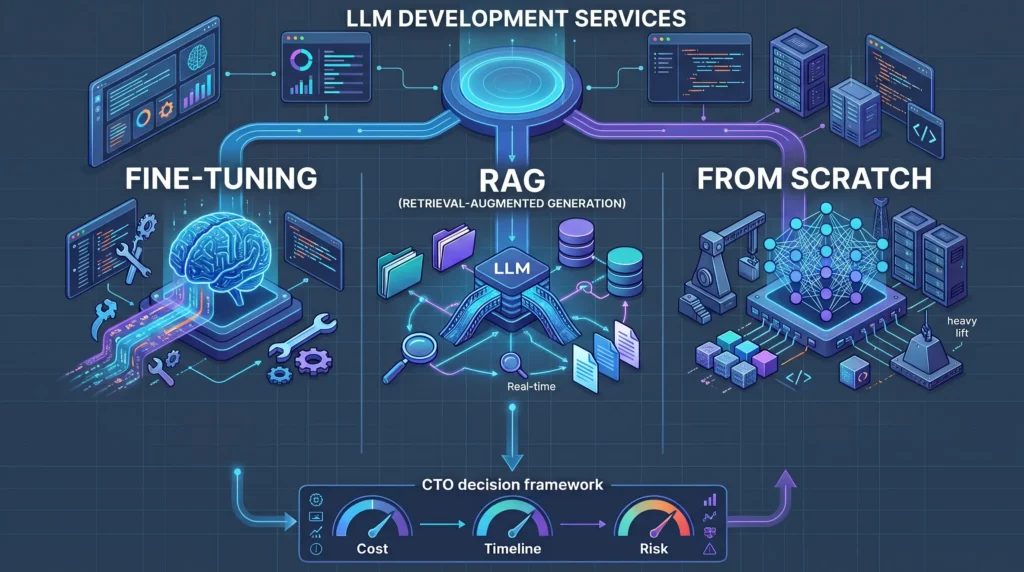
In most cases, the right build is the cheapest one that hits your accuracy, cost, and data-control targets. The table below orders the options from least to most custom.
| Build type | What it is | Best for | Main risk |
|---|---|---|---|
| Off-the-shelf AI tool | A packaged product with AI features | Common tasks such as meeting notes or support macros | Little control over data, accuracy, or roadmap |
| Prompted foundation model | A commercial large language model (LLM) called through an application programming interface (API) with engineered prompts | Drafting, summarization, classification | Output drifts when the vendor updates the model |
| Retrieval-augmented generation (RAG) | An LLM that answers from your own documents and data | Knowledge search, support, and internal assistants | Weak retrieval produces confident wrong answers |
| AI agent | A highly autonomous system that plans steps and acts in your tools | Multi-step workflows with clear rules | Errors can compound across steps, and long reasoning loops drive up token costs |
| Fine-tuned model | A pre-trained foundation model trained further on your examples | A narrow task at high volume, or a fixed tone or format | Retraining required each time the base model changes |
| Custom ML model | A task-specific model, such as a forecasting or image recognition model, trained on your own data instead of adapted from an LLM | Forecasting, scoring, fraud detection, computer vision | Needs clean labeled data and regular retraining as real-world data drifts |
Agents now have their own vendor market; see our list of top AI agent development companies if that’s your main use case.
Key takeaway: Ask a vendor which row of this table it would start with and why. A partner that proposes fine-tuning before testing retrieval is pricing in work you may not need.
Should you hire a custom AI development company, augment your team, or buy?
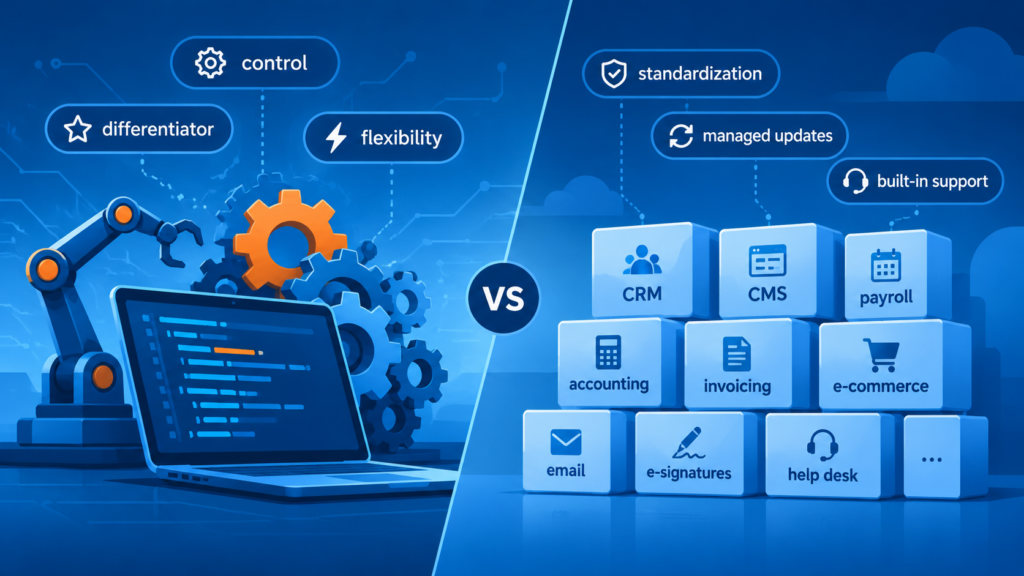
Hire a vendor when you need a production system and lack the team to build it. Augment when you want to manage delivery yourself but lack in-house AI/ML expertise. Buy when a product already solves the problem well enough. Most companies end up mixing two of these routes.
| Route | When it fits | What you own | Main risk | Where to look in this list |
|---|---|---|---|---|
| Buy a platform or tool | The use case is common and your data isn’t a differentiator | Configuration and prompts | Lock-in and limited accuracy tuning | Outside this list |
| Hire a custom AI development company | You need a working system and a team that answers for the outcome | Code, models, and data pipelines, if the contract says so | Weak handover leaves you dependent on the vendor | Product engineering firms, AI and ML studios |
| Dedicated team | AI is a long-term product capability, not a one-off project | Roadmap, backlog, and all deliverables | Slow results if you lack a product owner | Product engineering firms, enterprise engineering firms |
| Staff augmentation | You have tech leads and need ML or data engineers fast | Everything; you manage the work | Management load shifts to your team | Toptal, plus firms that offer both models |
| Hire in-house | AI is your core product and you have the time and budget to hire senior ML talent | Everything | The highest fixed cost of any route, plus long hiring cycles | Not a vendor decision |
Many vendors on this list offer more than one route. AgileEngine, for example, runs dedicated teams and team augmentation alongside end-to-end delivery, so you can switch engagement models without changing vendors.
Cut software engineering and design costs by over 50% by engaging thoroughly vetted experts across 15+ global hubs.
Talk to our expertsHow we selected the top custom AI development companies
We reviewed vendors that offer custom AI development services, drawing on search results, Clutch’s AI development listings, and existing industry rankings. We kept 12 that met four criteria:
- Documented delivery: published case studies or verified client reviews covering custom AI or ML work.
- AI as a core service line: AI and ML listed as a primary offering, not only as a feature of other services.
- Capacity for production work: enough ML, data, and software engineers to build, integrate, and run a system after launch.
- Verifiable public data: a company website plus a Clutch or LinkedIn profile we could check facts against.
We took ratings, hourly rates, and minimum project sizes from Clutch; founding year, headquarters, delivery locations, and case studies from company websites; and headcount from company reports and filings, or from Clutch where nothing more precise is published.
All data was checked in November 2026. Companies are grouped and ordered by their primary segment, and some also list a secondary one. The list isn’t scored, and AgileEngine, the publisher of this article, appears first. We plan to update the list every 6 to 12 months.
Top custom AI development companies at a glance
The 12 companies below fall into four segments: specialized AI and ML studios, product engineering firms, enterprise engineering firms, and an AI talent network. Use the “Best for” column to narrow your shortlist before reading the profiles.
| Company | HQ and delivery regions | Core custom AI services | Team size | Best for |
|---|---|---|---|---|
| AgileEngine | Boca Raton, FL; US, Latin America, Europe, India | AI consulting, ML and predictive analytics, computer vision, generative AI | 900+ | Dedicated AI teams backed by a large engineering bench |
| deepsense.ai | Warsaw, Poland; Europe, US | LLM systems, computer vision, MLOps | 120+ | Research-heavy ML and LLM engineering |
| InData Labs | Nicosia, Cyprus; Lithuania, US | Predictive analytics, NLP, generative AI | 80+ | Data science projects with a mid-size budget |
| Master of Code Global | Winnipeg, Canada; North America, Latin America, Europe | Conversational AI, voice bots, AI agents | 150+ | Customer-facing chat and voice AI |
| Tooploox | Wroclaw, Poland; Europe, US via Solvd | Computer vision, ML research, AI products | About 170 | Vision-heavy and R&D-led products |
| 10Pearls | Vienna, VA; US, Latin America, UK, Pakistan | AI apps, computer vision, conversational AI | 1,400+ | AI in regulated apps, such as healthcare and fintech |
| HatchWorks AI | Atlanta, GA; US, Costa Rica, Colombia, Peru | AI strategy, RAG, data platforms, AI-native products | 200+ | Nearshore AI teams in US time zones |
| ScienceSoft | McKinney, TX; US, Baltics, Poland, UAE | Computer vision, predictive analytics, AI assistants | 750+ | Fixed-scope AI projects with compliance needs |
| Quantiphi | Marlborough, MA; North America, India | Generative AI platforms, document AI, cloud AI | 3,000+ | Google Cloud-centered AI programs |
| Grid Dynamics | San Ramon, CA; Americas, Europe, India | Enterprise AI engineering, data platforms | About 4,800 | Fortune 1000 AI and platform engineering |
| EPAM Systems | Newtown, PA; global | Applied AI, AI-native delivery, data and evaluation | 60,000+ | Global enterprise programs at scale |
| Toptal | Remote-first; global network | Vetted freelance ML and AI engineers | Talent network | Adding ML specialists to your own team fast |
The 12 best custom AI development companies in 2027
For each company, you’ll find what it builds, where it delivers from, and the projects it suits best, backed by case studies and industry recognition. Companies are grouped by segment, starting with specialized AI and ML studios.
1. AgileEngine
AgileEngine, founded in 2010, runs an AI Studio that takes on custom AI projects, from computer vision and forecasting to generative AI assistants and agents. The studio also advises engineering teams on adopting AI across their delivery process. Besides its own AI team, the studio shares the talent pool, candidate base, and hiring system of AgileEngine’s wider engineering organization. Clutch named AgileEngine a Top Machine Learning Company for 2025–2026.
- Segment: Specialized AI and ML studios (secondary: product engineering firms)
- Core services: AI consulting and roadmaps, ML and predictive analytics, computer vision, generative AI assistants and agents, data and MLOps engineering, AI adoption in software delivery
- Delivery locations: US, Mexico, Argentina, Colombia, Brazil, Guatemala, Poland, Spain, Portugal, Ukraine, Romania, Bulgaria, Slovenia, Slovakia, and India
- Clutch: 5.0 from 60 reviews; $25–$49 per hour; projects from $25,000
- Track record: AgileEngine built an ML-powered predictive maintenance system that helps an AI startup launched with a top-5 luxury car brand predict failures across tens of thousands of electric vehicles. The solution analyzes vehicle telemetry and flags likely battery failures. The system delivered up to 95% savings on component guarantees and cut the manufacturer’s quality assurance (QA) time by up to 90%.
- Best for: Companies that want a dedicated AI team for a product or process they own, with engineering capacity that scales around it.
2. deepsense.ai
deepsense.ai grew out of the AI division of Warsaw software company CodiLime in 2014. It builds LLM, computer vision, and ML systems for enterprise clients in Europe and the US and also offers AI team augmentation. Its team of more than 120 AI specialists includes Kaggle competition winners and PhD researchers. Many of its LLM projects run on ragbits, an in-house generative AI framework.
- Segment: Specialized AI and ML studios
- Core services: LLM and RAG systems, AI agents, computer vision, MLOps
- Delivery locations: Poland and the US
- Clutch: 5.0 from 11 reviews; $100–$149 per hour; projects from $25,000
- Track record: deepsense.ai developed an email automation proof of concept for InterRisk, an insurer whose customer service inbox receives about 30,000 emails a month. Staff had been reviewing, classifying, and re-entering each message by hand. In three weeks, the system classified those emails with 85% accuracy and cut handling time from about 5 minutes to about 30 seconds each.
- Best for: Teams that need research-grade ML or LLM engineering from a senior, Europe-based core team.
3. InData Labs
InData Labs has focused on data science and AI since its launch in 2014. It has offices in Cyprus, Lithuania, and Miami, and runs its own AI research and development practice. The company reports a team of 80+ data science and AI specialists. It has delivered more than 150 projects across three continents, for clients such as Flo and Wargaming.
- Segment: Specialized AI and ML studios
- Core services: Predictive analytics, natural language processing (NLP), computer vision, generative AI
- Delivery locations: Cyprus, Lithuania, and the US
- Clutch: 4.9 from 20 reviews; $50–$99 per hour; projects from $10,000
- Track record: InData Labs helped AsstrA, a global transport and logistics company, accelerate freight rate analysis and order coordination. Its engineers implemented freight rate prediction software based on machine learning that pulls data from AsstrA’s transport management system and automates the quotes. The software doubled prediction accuracy and significantly cut the agents’ manual analysis time.
- Best for: Forecasting and data science projects with a mid-size budget.
4. Master of Code Global
Master of Code Global started as a software development company in 2004 and later made conversational AI its specialty. AI development, AI agents, AI consulting, and generative AI make up most of its Clutch-listed work. In September 2026, Clutch certified it in AI development as well as custom software development. The company’s clients include T-Mobile, Verizon, and Tom Ford, and it built LOFT, an open-source framework for orchestrating LLMs.
- Segment: Specialized AI and ML studios
- Core services: Conversational AI, voice bots, AI agents, generative AI
- Delivery locations: Canada, the US, Argentina, Brazil, Poland, Portugal, and Ukraine
- Clutch: 4.7 from 37 reviews; $50–$99 per hour; projects from $25,000
- Track record: According to a verified Clutch review, Master of Code replaced a consulting firm’s legacy interactive voice response (IVR) system with an AI voice bot connected to the client’s CRM through its REST API. The firm’s head of project management described the team as professional, adaptable, and solution-oriented.
- Best for: Customer-facing chat and voice experiences tied to CRM and contact-center systems.
5. Tooploox
Tooploox began as a mobile-focused startup in Wroclaw in 2012, grew into an AI software company, and was acquired by Solvd in 2025. Its ML researchers have published more than 30 peer-reviewed papers at venues such as NeurIPS and ICML. The company reports 100+ completed AI projects over more than a decade, for clients such as eBay and ETH Zurich.
- Segment: Specialized AI and ML studios
- Core services: Computer vision, ML research, generative AI products, product design
- Delivery locations: Poland, with US market access through Solvd
- Clutch: Reported project budgets from $30,000 to over $1 million
- Track record: Tooploox engineers, researchers, and designers contributed to Light’s Clarity platform, a multi-camera depth perception system for driver-assisted and autonomous vehicles. Light says the platform uses passive cameras to detect 3D structures from 10 centimeters to 1,000 meters away, about three times the range of the best lidar (light detection and ranging) sensors.
- Best for: Vision-heavy products and research-led work where the model itself is the hard part.
6. 10Pearls
Founded in 2004 as a two-person operation in Pakistan, 10Pearls is now headquartered in Vienna, Virginia, and employs more than 1,400 people. In addition to AI expertise, the company offers custom software, mobile, and cloud services. Its published AI work spans healthcare, legal, financial services, and agriculture, from agentic assistants to facial recognition. Forrester has featured the company as an AI consultancy, and Gartner has listed it for AI consulting and system integration.
- Segment: Product engineering firms
- Core services: Custom AI applications, computer vision, conversational and agentic AI, model monitoring
- Delivery locations: US, Colombia, Costa Rica, Peru, UK, and Pakistan
- Clutch: 4.9 from 36 reviews; $25–$49 per hour; projects from $50,000
- Track record: 10Pearls built an ML-based facial recognition system for a genealogy platform. The system recognizes facial features even in low-quality photos and records, and it combines similarity scoring with record metadata to match relatives. It reached 94% match accuracy and cut processing time to 4 minutes.
- Best for: Mid-market and enterprise teams adding AI to products in regulated industries.
7. HatchWorks AI
HatchWorks AI has operated from Atlanta since 2016 and now positions itself as a pure-play AI firm. It builds with Generative-Driven Development, its method for using AI across the delivery process, from nearshore hubs in Latin America. The company reports 97% year-over-year client retention. It belongs to the OpenAI and Claude partner networks and is also a Google Cloud and Databricks partner.
- Segment: Product engineering firms
- Core services: AI strategy and roadmaps, RAG, AI agents, data platforms, AI-native products
- Delivery locations: US, Costa Rica, Colombia, and Peru
- Clutch: 4.9 from 26 reviews; most common project size $200,000–$999,999
- Track record: Cox2M, an Atlanta-based Internet of Things (IoT) company, partnered with HatchWorks to add a generative AI assistant to its vehicle GPS and health platform for small fleets. The assistant lets fleet managers ask questions about trips, hard braking, or mileage in plain language. A RAG system on Google Cloud’s Vertex AI then pulls real-time answers from their vehicles’ IoT data.
- Best for: US companies that want a nearshore AI team in their time zone, from strategy through build.
8. ScienceSoft
ScienceSoft began as an AI product company in 1989 and has since grown into an IT consulting and software development firm. Its 750+ experts deliver AI work across healthcare, manufacturing, finance, and retail. It reports 4,300+ completed projects for 1,500+ clients, including IBM, Ford, Walmart, and NASA.
- Segment: Product engineering firms
- Core services: Computer vision, predictive analytics, AI assistants, intelligent document processing
- Delivery locations: US, Latvia, Lithuania, Poland, and the UAE
- Clutch: 4.8 from 46 reviews; $50–$99 per hour; projects from $5,000
- Track record: For Cerulean, a UK maker of testing equipment, ScienceSoft replaced an unreliable computer vision model with a production-ready machine learning model that automatically segments and measures products in conveyor images. It reached 97% accuracy on 2,000 production images within two months and processes images 6 times faster.
- Best for: Fixed-scope AI projects with documented requirements and compliance needs.
9. Quantiphi
Quantiphi started in Marlborough, Massachusetts, in 2013 as a data science and machine learning company and now markets itself as an AI-first digital engineering firm. It has more than 3,000 employees and a long-running partnership with Google Cloud. The company reports more than 50 Fortune 500 clients. It has won 21 Google Cloud Partner of the Year awards, and in November 2026 it became a launch partner for Gemini for healthcare.
- Segment: Enterprise engineering firms
- Core services: Generative AI platforms, document AI, conversational AI, data and cloud modernization
- Delivery locations: US, Canada, and India
- Track record: NelsonHall named Quantiphi a Leader in its 2025 NEAT evaluation for generative AI and process automation in banking.
- Best for: Enterprises standardizing AI on Google Cloud, especially in banking and insurance.
10. Grid Dynamics
Grid Dynamics trades on Nasdaq and runs its engineering services business from Silicon Valley, where it was founded in 2006. It reported 4,838 employees at the end of June 2026. The same year, it rolled out GAIN, a set of agentic AI platforms for commerce, software delivery, risk and compliance, and physical AI. AI work made up 29.3% of its revenue in the first quarter of 2026, growing nearly 60% year over year.
- Segment: Enterprise engineering firms
- Core services: Enterprise and agentic AI engineering, data and ML platforms, cloud and platform modernization
- Delivery locations: Americas, Europe, and India
- Track record: Forrester recognized Grid Dynamics among leading AI service providers in 2022 and 2024.
- Best for: Fortune 1000 companies modernizing platforms and data alongside AI.
11. EPAM Systems
EPAM Systems opened in 1993 with three employees and is now a NYSE-listed digital engineering company based in Newtown, Pennsylvania. In 2026, it joined OpenAI’s partner network as an Advanced Partner and announced a partnership with Anthropic. More than 20,000 EPAM employees have completed training through Anthropic Academy. It serves 345+ Forbes Global 2000 clients and operates in 55+ countries and regions.
- Segment: Enterprise engineering firms
- Core services: Applied AI and agents, AI-native software delivery, data and evaluation services for AI models
- Delivery locations: Global, across North America, Europe, Latin America, and Asia
- Track record: Telecom provider 1&1 credits EPAM with deploying AI tools for its phone and digital customer support. The resulting agentic platform uses more than 20 AI agents to handle a significant share of 1&1’s weekly customer calls, and its first production deployment took under three months.
- Best for: Large enterprises running multi-country AI programs under strict security and compliance rules.
12. Toptal
Toptal has run a remote-first talent network since 2010. It says fewer than 3% of the 200,000+ people who apply each year join its network. By Toptal’s count, its deep learning experts average a 4.9 out of 5 client rating across 1,809 reviews. It reports 30,000+ clients in 140+ countries and more than 85,000 hires to date.
- Segment: AI talent and staff augmentation
- Core services: Freelance ML engineers, data scientists, and AI architects; managed delivery for full projects
- Delivery locations: Global, fully remote
- Track record: Toptal assembled the engineering team behind Ask Ari, USC’s AI mental health chatbot, which gave more than 40,000 students 24/7 support. Toptal engineers paired an AI-driven knowledge tree with natural language processing so the chatbot could adapt its guidance to each student, and optimized the app to work across devices.
- Best for: Teams with their own tech leads that need ML specialists fast; Toptal says it typically fills ML roles in about 48 hours.
Key takeaway: Clutch ratings on this list cluster between 4.7 and 5.0, so they won’t separate your finalists. Track records will: ask each shortlisted vendor for a case study that matches your build type.
Increase the ROI of software projects by over 3x with AI-augmented remote development and design solutions tailored to your business goals.
Book a consultationHow to choose a custom AI development company
Choose by matching three things: the build type you need, the vendor’s proof in that build type, and how it handles evaluation and ownership. A strong general reputation can’t stand in for any of the three.
Match the vendor type to your build
Different builds stress different skills. A RAG assistant is mostly integration and data work, while a forecasting model is mostly data science.
| If you need | Start with | Why |
|---|---|---|
| An AI feature or assistant inside an existing product | Product engineering firms | Integration, security, and user experience (UX) take most of the effort, not the model |
| A forecasting, scoring, or fraud model | Specialized AI and ML studios | Feature engineering and validation need dedicated data scientists |
| Computer vision on images or video | Specialized AI and ML studios | Labeled data, edge cases, and accuracy testing need deep ML skills |
| Chat or voice for customers | Studios with conversational AI focus | Dialogue design and contact-center integration are a specialty |
| A multi-country program on one cloud platform | Enterprise engineering firms | Scale, cloud partnerships, and governance across regions |
| ML capacity for a team you already run | AI talent networks or staff augmentation | You keep control of the roadmap and pay only for the skills you lack |
Questions to ask before you sign
These questions work under a nondisclosure agreement (NDA) and don’t require a live demo. Strong answers come with specifics; weak ones stay at the level of marketing.
| Question | Strong answer | Red flag |
|---|---|---|
| Which build type would you start with, and when would you move up? | Starts with the simplest option and names a measurable threshold for moving up | Proposes fine-tuning or agents before testing a baseline |
| How do you test model output before launch? | Test sets built from your data, accuracy and safety thresholds agreed upfront, and regression tests on model updates | “Our team reviews outputs manually” |
| Can you walk us through an anonymized project like ours? | Architecture, metrics, and what went wrong, without naming the client | Logos and adjectives only |
| Who owns the code, prompts, models, test sets, and pipelines at the end? | You do, in your repositories, written into the contract | Running the system requires the vendor’s licensed platform |
| How will you track cost and drift after launch? | Cost-per-request dashboards, drift alerts, and a retraining plan | Support ends at go-live |
| Who will actually work on the project? | Named roles, seniority mix, and a plan for continuity | Team details come “after signing” |
| How do you handle data security and regulation? | Data stays in your cloud, ISO 27001 or SOC 2 controls, and a plan for EU AI Act duties where they apply | Your data goes to third-party APIs without a data processing agreement |
Key takeaway: Ask for the evaluation plan in the proposal, not after kickoff. A vendor that can’t describe how it will measure accuracy before launch can’t prove it delivered.
How much do custom AI development services cost?
Custom AI development ranges from a few weeks of work for a proof of concept to six- and seven-figure budgets for production programs. On Clutch, hourly rates for firms on this list run from $25–$49 to $100–$149, and minimum project sizes run from $5,000 to $50,000.
| Stage | Typical scope | Reference points from this list |
|---|---|---|
| Proof of concept | One use case tested on a sample of your data | deepsense.ai ran InterRisk’s email-processing proof of concept in three weeks |
| Production model or feature | Integration, evaluation, security review, and monitoring | ScienceSoft delivered Cerulean’s production vision model in two months |
| Multi-use-case program | Shared data platform, several AI features, ongoing operations | HatchWorks AI’s most common Clutch-reported project size is $200,000–$999,999 |
The build is only part of the bill. Four items drive the rest:
- Data preparation: cleaning, labeling, and connecting the data the model depends on.
- Integration: wiring the model into existing systems, identity, and permissions.
- Evaluation: building test sets and rerunning them each time the model or prompts change.
- Running costs: inference, tokens, and monitoring. About 1 in 5 respondents in McKinsey’s 2026 survey said AI operating costs already limit how much their organization uses AI.
Ask vendors to price running costs per request or per month alongside the build. A cheap build with an expensive inference bill isn’t cheap.
What does a custom AI development project look like?
A well-run custom AI project moves through six stages, each ending in a decision to continue, change course, or stop. The stages below assume a vendor-led build; with staff augmentation, your team owns the same steps.
- Discovery: pick one use case with a business metric attached, such as handling time, error rate, or revenue per user. Deliverable: a one-page problem statement with a target.
- Data readiness: check whether the data exists, who owns it, and what it would take to use it. Deliverable: a data audit and a go or no-go call.
- Proof of concept: test the simplest build that could work against a baseline. Deliverable: measured results on your data, not a demo on sample data.
- Evaluation design: turn the proof-of-concept tests into a repeatable test set with agreed thresholds for accuracy, safety, and cost.
- Production build: integrate with your systems, add guardrails and logging, and pass a security review. Deliverable: a system that meets the thresholds from stage 4.
- Operations: monitor accuracy, drift, and cost per request, and retrain or re-prompt when results slip. Each change goes back through the stage 4 test set.
Key takeaway: Stages 2 and 4 are the easiest to cut when budgets tighten, and they decide whether a pilot reaches production. Budget time for both in the first contract.
When AgileEngine is the better fit
AgileEngine fits best when you want a dedicated AI team backed by a large engineering organization. Its AI Studio runs projects from a short discovery session through a 4–8 week proof of concept to a 2–9 month implementation, with ongoing support and model retraining after launch. Clutch named AgileEngine a Top Machine Learning Company for 2025–2026. It is also an AWS Select Tier Services Partner and a certified Google Cloud Partner.
Selected AI Studio work beyond the profile above:
- Decision intelligence: for SYNRG.Ai, a minimum viable product (MVP) scoring engine that pairs deterministic scoring with an LLM recommendation layer and a context-bounded RAG pipeline.
- Energy management: an agentic platform that uses optical character recognition (OCR), NLP, and computer vision to audit and forecast energy contracts and invoices, taken from greenfield to first release in two months.
- Enterprise data platform: for a storage provider serving 84% of Fortune 500 firms, a computer vision proof of concept with vision-language model and vector database integration, plus 90–95% automated test coverage across platform services.
AgileEngine is likely a good fit if:
- You need ML, computer vision, or generative AI work from a dedicated team, with data, backend, and QA engineers available as scope grows.
- You want help adopting AI assistants and agentic workflows in your own engineering process, starting with an assessment of where delivery time is lost.
- You need engineers in US-friendly time zones, with delivery hubs across Latin America and Europe.
- You want your code, prompts, models, and test sets kept in your own repositories.
A different vendor on this list may fit better if you need academic-grade research on new model architectures, a program tied to one cloud provider across many countries, or individual freelancers rather than a managed team.
How to move forward with a custom AI development company
Start with one use case and one number. Write down the metric you want to move, the data that feeds it, and the build type you expect to need. Then shortlist two or three vendors from the matching segment and send each the questions above before any call.
Compare the answers on evaluation and ownership first, and on price second. If AI is going into a product you own, talk to an AgileEngine AI Studio lead about your use case, and ask for a proof-of-concept plan with the success metric written in.
Grow faster with dedicated teams of top 1% software experts, speeding up time-to-hire by 3x and project delivery by 2x.
Let’s talkFrequently asked questions
No. AI consulting firms focus on strategy, use-case selection, and governance, while a custom AI development company builds, integrates, and runs the system. Many vendors offer both, so ask who will write and maintain the code after the strategy phase.
They add data science, model evaluation, and MLOps to regular engineering work. In practice, that means test sets for model accuracy, monitoring for drift, and a plan for retraining. A software firm with an AI practice can cover this if it has dedicated ML engineers and published AI case studies.
Yes, and it’s a common choice when data can’t leave your infrastructure. In deepsense.ai’s InterRisk project, for example, the proof of concept ran on an open-source model hosted inside the client’s own environment. Expect more infrastructure and evaluation work than with a commercial API.
Ownership depends on the contract, not on who paid for the build. Make sure assignment clauses explicitly cover trained model weights, fine-tuning data, prompts, and test sets. Vendors usually keep rights to their pre-existing tools and license them to you.
It can. The Act covers providers that place AI systems on the EU market and, in some cases, systems whose output is used in the EU, wherever the provider is based. If your product serves EU users, ask vendors how they would document a high-risk system before you sign










![A smartphone and a tablet with monetization elements (banner ad and in-app purchase button) displayed on the screen]](https://agileengine.com/wp-content/uploads/2026/03/How-Do-Free-Apps-Make-Money_-Monetization-Explained.webp)